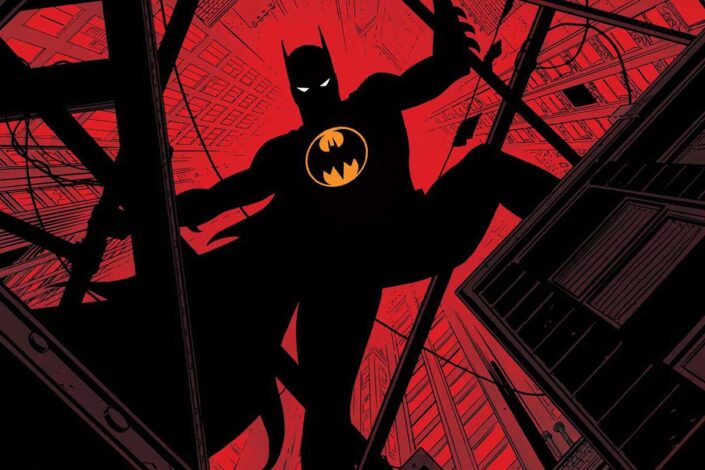
When it comes to superhero movies, people are no longer interested in origin stories, but comic book readers and writers are still passionate about what made a character become the crime fighter they are known to be. During the post-Crisis era, Batman’s early years as the Caped Crusader were explored in depth. Perhaps to the degree that DC Comics lost interest. A few decades later, the past feels more present than ever, with writers regularly revisiting the lore they discovered as readers and modernizing dated elements. But it goes even further. It’s not just about comic books from the past, it’s about giving characters a place in their own history. That said, this book is perfect for any new reader looking to enjoy a complete Batman tale.
Written by Dan Watters with art by Hayden Sherman, Batman: Dark Patterns is a 12-issue miniseries that explores Gotham City’s past and carves out a place for its greatest detective within it. Set around Batman’s third year, the story is divided into four thematically linked investigations that slowly build upon each other to form a larger tale.
Each case starts as an apparently self-contained crime. Batman follows leads, questions suspects, and moves methodically through the city. He collaborates with Jim Gordon, who introduced him to Dr. Sereika, a forensic pathologist at Gotham University. Sereika is an odd man, but a competent one. His insights are valuable, but his attitude is suspect. Like everybody else, he has secrets. Dark Patterns is about uncovering those secrets, and everyone else’s, especially those rooted in Gotham’s past.
For a time, when I started reading Batman comics, I had a hard time understanding the label “world’s greatest detective,” since most stories had him chasing a supervillain and running around to catch him. The mystery was about how Batman was going to stop the bad guy. It was not impressive detective work. I have come to accept that Batman’s role as a detective is often overshadowed by his action-hero persona and the ever-ambitious plots involving supercriminals. Not all comic book writers are interested in plotting mysteries, and the Dark Knight is a versatile character.
That said, in his miniseries, Dan Watters clearly wanted to showcase Batman’s detective skills. Although there are fights and explosive action scenes, the heart of each of the four three-part stories is the investigation. It’s about digging deep to uncover the origins of a crime and find the true culprits. In doing so, we explore Gotham’s violent past.
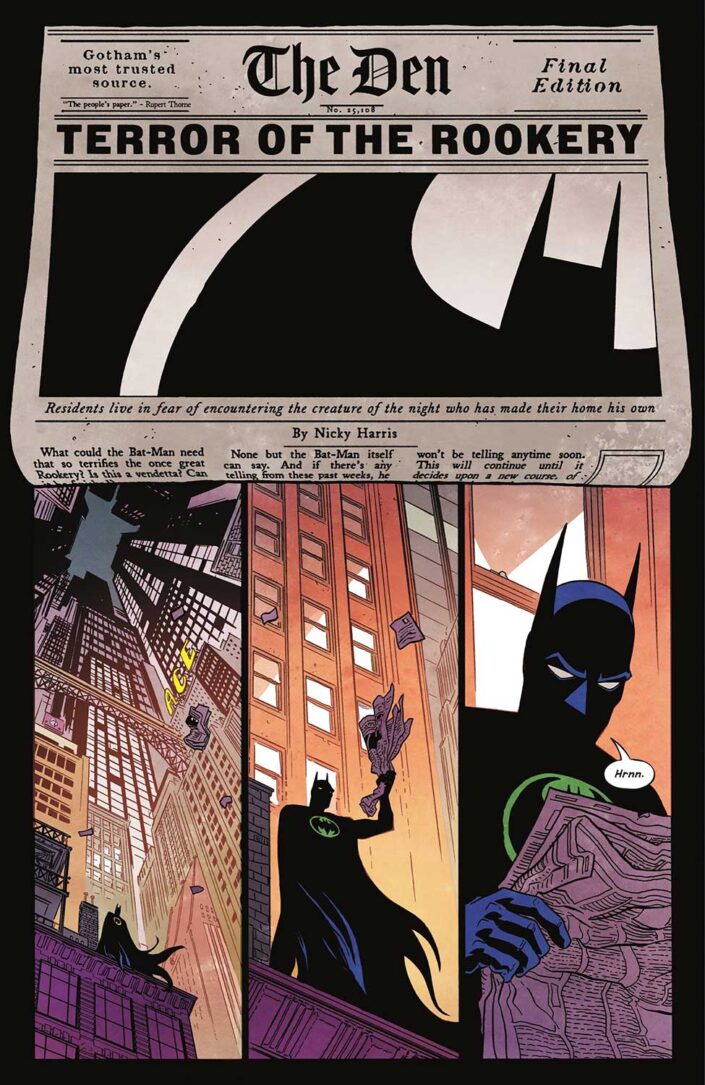
It is here that Hayden Sherman’s art elevates the entire series. His compositions are lively, and the way he drew the city reminded me of the pop-retro-noir aesthetic of the 1992 animated series, but with a more precise pencil technique that added texture to the nostalgia. His depiction of Gotham is richly layered and brings its history to life. When parts of it go up in flames, it’s not just buildings that are destroyed. Talking of buildings, the second story (issues 4–6), inspired by the film The Raid, is an impressive feat. It features an apartment tower where echoes lead Batman into a claustrophobic maze of stairs and hallways in search of the truth.
Triona Farrell’s colouring also perfectly captures the story’s nostalgic aesthetic, using muted colours that still contrast with the shadows, ensuring that Batman stands out even in the darkest places. In fact, the comic is surprisingly full of colour, not just because fire is a recurring visual element. Gotham is not a black hole of despair, it’s alive.
Batman: Dark Patterns is as visually captivating as it is well-written. The series follows Batman as he strives to become a better detective by gaining a deeper understanding of Gotham City. It’s a crime story examining how past violence festers and gives rise to new violence. Understanding the past is the key to preventing it from repeating itself. It works really well as an early Batman tale and delivers on its promise of being a detective story. I’m a crime comics fan as much as I’m a Batman fan, and this miniseries became for me an instant favourite. It’s a perfect illustration of how Batman’s detective and action hero personas can really work together.

If you like Batman: Dark Patterns, Phillip Kennedy Johnson explored similar themes in a present setting in his Batman and Robin run. To learn where those stories are set in the current continuity, check out our Batman All In Reading Order.