
With the launch of the Batman: The Animated Series, a new and popular version of the DC Comics universe found its way to a new generation of fans. While not connected to the main line of comics, it borrowed a lot, adapted many comics into episodes, and also created new stories and characters that would eventually be later introduced in the canonical timeline of the post-Crisis DC Comics Universe.
With its easily recognizable art style and its own developing universe, Batman: TAS opened the way for what we know call the DC Animated Universe. Guided by producers Bruce Timm, Paul Dini, Alan Burnett, and others, it’s whole universe of animated shows that was created with Superman: The Animated Series (1996–2000), Batman Beyond (1999–2001), and Justice League (2001–2004) along with its follow-up Justice League Unlimited (2004–2006), but also a new line of comics was launched.
Although primarily aimed at younger readers, the comics were noted for their storytelling quality, which appealed to a broader audience. It often introduced original characters, bridged episode narratives, and explored side stories within the DCAU continuity. Serving both as accessible entry points for new readers and as canonical expansions of the animated franchise, the comics were typically written and illustrated by creators closely associated with the animated productions, including Kelley Puckett, Ty Templeton, and Rick Burchett, ensuring fidelity to the shows’ tone, characterizations, and art style.
Over time, the DCAU comics evolved into a cohesive publishing universe in their own right. The universe has been revisited through miniseries, specials, and digital-first projects well into the 2020s, establishing it as one of DC Comics’ most enduring multimedia spin-offs.
DC Animated Universe Comics Reading Order
A word on continuity. You don’t have to watch any of the shows to read those comics. Although the DCAU comics were created as direct tie-ins to the animated series, their production was not dictated by the shows’ writing staff (even though some of them also wrote a few comics). This gave the comic creators the freedom to maintain the series’ visual style and tone while telling original stories and occasionally introducing new characters or settings. Consequently, the comics can be enjoyed independently while also functioning as an extension of the animated continuity. Their canonicity can best be described as ‘soft’: some issues are direct adaptations of episodes or films, while others include elements that conflict with the shows. In all cases, the animated series takes precedence, but its largely episodic format has minimized major continuity conflicts between the two mediums. Notably, some characters and concepts introduced in the comics, such as Roxy Rocket and Harley Quinn’s origin story in Mad Love, were later incorporated into the animated series. This further blurred the boundary between the two.
The Batman Adventures Volume 1 (1992-1995)
Launched in 1992 alongside Batman: The Animated Series, The Batman Adventures was the first comic series set in what would become the DC Animated Universe. Published by DC Comics, the title ran for 36 issues and two annuals, closely mirroring the animated show’s art style, tone, and character designs. Written primarily by Kelley Puckett and illustrated by artists like Ty Templeton and Mike Parobeck, the series embraced the noir-inspired aesthetic and mature yet accessible storytelling that defined the cartoon, making it stand out from other Batman comics of the era.
While the series followed the spirit of the TV Show, it was a companion rather than a strict adaptation, telling original stories that expanded on Gotham City’s world and characters.
- The Batman Adventures Omnibus
Collects The Batman Adventures #1-36, The Batman Adventures Annual #1, The Batman Adventures Annual #2, The Batman Adventures Holiday Special #1, The Batman Adventures: Mad Love #1, and stories from Batman: Black & White Omnibus.
The Batman & Robin Adventures (1995-1997)
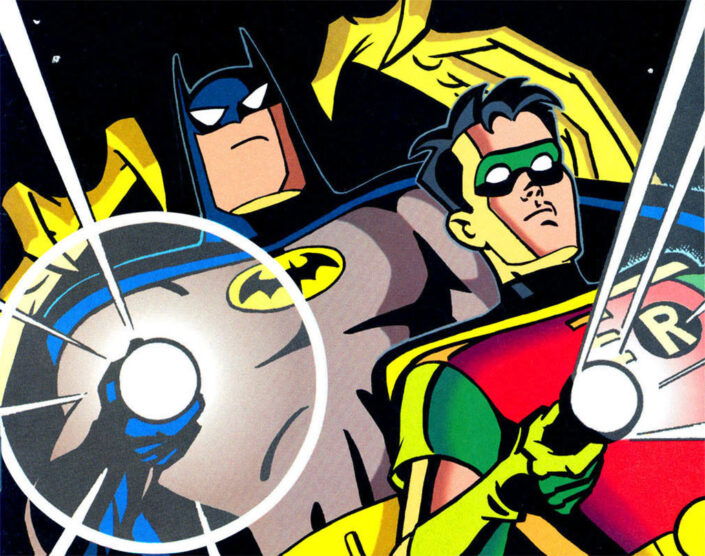
The Batman & Robin Adventures was the direct successor to The Batman Adventures. Written primarily by Ty Templeton with art by Rick Burchett, the series ran for 25 issues and two annuals.
- The Batman and Robin Adventures Omnibus
Collects The Batman & Robin Adventures #1-25, The Batman & Robin Adventures Annual #1-2, The Batman Adventures: The Lost Years #1-5, and The Batman & Robin Adventures: Sub-Zero #1, and more!
Superman & Batman Magazine (1993-1994) – Published by Welsh Publishing Group for the younger children’s market, Superman & Batman Magazine ran for eight issues between 1993 and 1995. Though not a strict tie-in title, it featured stories and artwork heavily inspired by Batman: The Animated Series. It was short stories, fun facts, games, and articles about the world of comics and superheroes. The magazine mixed continuities (from the main DC Comics Universe and the Animated series) and what’s in it is considered to have been retconned. More of an artifact for collectors.
I Love to Read Batman (1993-2001) – Another children’s magazine, this one was from Europe, published by Redan Publishing in the UK. It lasted for 69 issues (and was renamed I Love to Read Batman and Superman with issue #23).
Superman Adventures (1996-2002)
Superman Adventures was the first comic series based on Superman: The Animated Series. It ran for 66 issues and one annual, making it the longest-running DCAU tie-in title. It was primarily written by Paul Dini, Mark Evanier, Devin Grayson, Scott McCloud, Mark Millar, and Ty Templeton, with art by artists such as Rick Burchett, Neil Vokes, and Aluir Amancio. Like its Batman counterpart, the series operated as a companion to the show rather than a strict adaptation, expanding its world and characters while maintaining continuity with the animated universe.
- Superman Adventures Compendium One
Collects: Superman Adventures #1-29; Superman Adventures Annual #1; Batman & Superman Adventures: World’s Finest #1; Superman Adventures Special: Superman/Lobo – Misery In Space #1 - Superman Adventures Compendium Two (2026)
Collects Superman Adventures #30-66 (TBC)
Adventures in the DC Universe (1997-1998)
Adventures in the DC Universe was a 19-issue anthology series (plus one annual) that presented all-ages stories featuring a wide range of DC superheroes, including Wonder Woman, The Flash, Green Lantern, and Aquaman.
Written primarily by Steve Vance with artwork by John Delaney and Ron Boyd, the series was not a direct tie-in to a show. It was designed as an accessible entry point for younger readers, spotlighting characters who had not yet appeared in animation or whose designs had not been standardized in the DCAU. As it predates Justice League (2001), it has been completely retconned.
The Batman Adventures: The Lost Years (1998)
Published as a five-issue miniseries in 1998, The Batman Adventures: The Lost Years bridged the gap between Batman: The Animated Series and its sequel series, The New Batman Adventures. Written by Hilary J. Bader with art by Bo Hampton, the series explained the changes seen in the new show, including Dick Grayson’s transition to Nightwing, Barbara Gordon’s expanded role as Batgirl, and the introduction of Tim Drake as the new Robin.
- Batman Adventures – Nightwing Rising
Collects The Batman Adventures: The Lost Years #1-5 and Batman: Gotham Adventures #1.
It has also been collected in The Batman and Robin Adventures Omnibus.
Batman: Gotham Adventures (1998-2003)
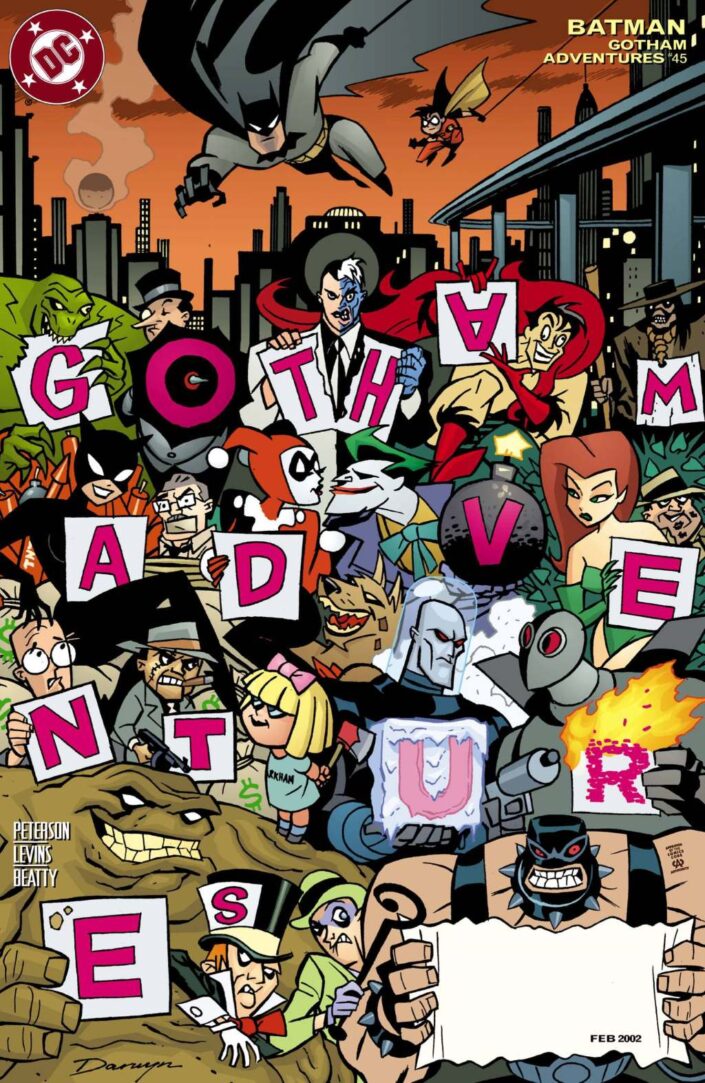
Batman: Gotham Adventures ran for 60 issues. Written primarily by Ty Templeton, and later by Scott Peterson, with art by Rick Burchett, Tim Levins, and Terry Beatty, the series adopted the updated character designs and darker aesthetic of The New Batman Adventures while maintaining an all-ages tone.
Although most issues told self-contained stories, Gotham Adventures gradually incorporated longer narrative arcs and more character development than its predecessors, deepening the relationships between Batman, his allies, and his rogues’ gallery.
- Batman: Gotham Adventures (Digital)
Collects Batman: Gotham Adventures #1–60 - Batman Adventures: Batgirl – A League of Her Own
Collects Batgirl Adventures #1 and Batman: Gotham Adventures #8-9, #22, and 38! - Batman Adventures: Riddle Me This!
Collects Batman Adventures #11 and Batman: Gotham Adventures #11, #28, and 56, 57.
Batman Beyond (1999-2001)
Published from 1999 to 2001, Batman Beyond was the first comic series based on the animated show of the same name. Mainly written by Hilary J. Bader with art by Rick Burchett and Mike Manley, the series ran for 24 issues and included several specials.
Set in a futuristic Gotham City, the series follows Terry McGinnis as the new Batman under the mentorship of an elderly Bruce Wayne. The comics mirrored the show’s visual style and tone while expanding on the stories of Terry, Bruce, and familiar DCAU villains, occasionally introducing new characters unique to the comic continuity. As usual, it was designed as a companion to the animated series rather than a strict adaptation.
- Batman Beyond: The Animated Series Classics Compendium – 25th Anniversary Edition
Collects Batman Beyond (vol. 1) #1-6, Batman Beyond (vol. 2) #1-24, and a guest appearance in Superman Adventures #64.
The Beyond Universe continued after that with a developing connection to the mainstream DC continuity. Things went in different directions for Terry through the years and we have a guide to help you navigate it fully.
Gotham Girls (2002-2003)
Gotham Girls was a six-issue miniseries (plus one annual) based on the Flash-animated web series of the same name, which spun off from The New Batman Adventures. Written by Paul D. Storrie and illustrated by Jennifer Graves, the series focused on the female characters of Gotham City, including Batgirl, Harley Quinn, Poison Ivy, and Catwoman.
Detective Renee Montoya is investigating the theft of a mysterious chemical compound, and follows the deadly trail of Poison Ivy and Harley. Meanwhile, Ivy tries to convince Catwoman and Batgirl to cooperate with her.
- Harley Quinn & the Gotham Girls
Collects Gotham Girls #1-5.
Justice League Adventures (2002-2004)
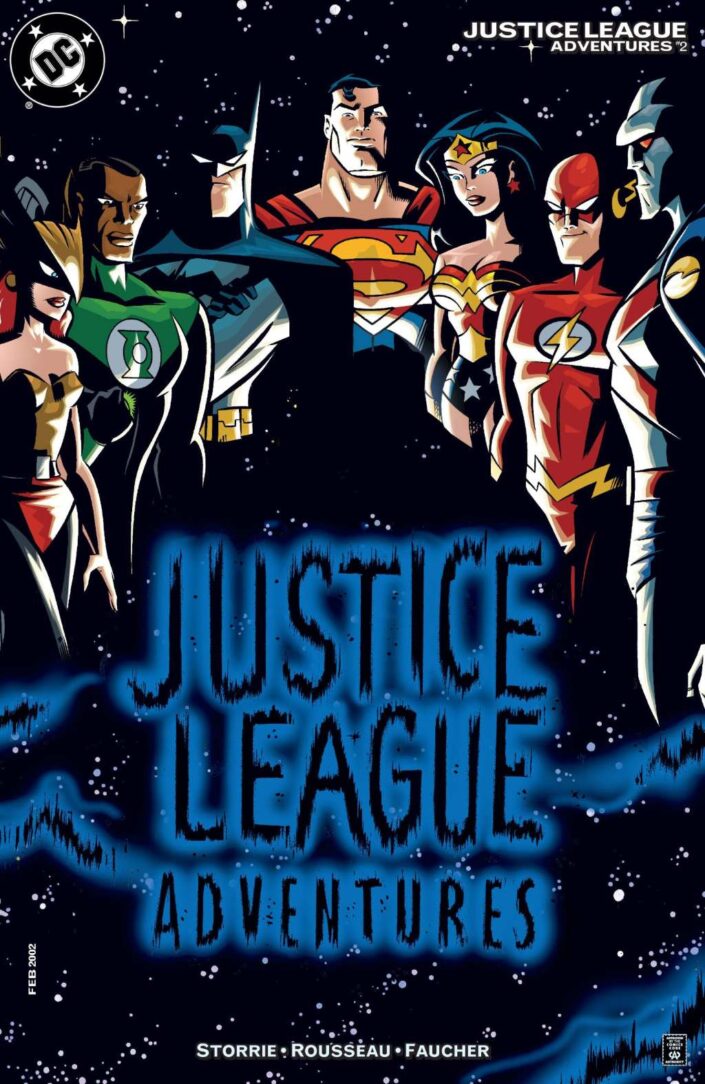
Justice League Adventures was the first ongoing comic series based on the Justice League animated series. Running for 34 issues, the series was written by various creators, including Fabian Nicieza, Christopher Sequeira, Josh Siegal, Dan Slott, and Ty Templeton, with art by John Delaney, Christopher Jones, Min S. Ku, and others. The series closely followed the visual style, tone, and characterizations of the animated show, emphasizing teamwork, humor, and action suitable for a broad age range. As usual, it was designed as a companion to the animated series rather than a strict adaptation.
- Justice League Adventures (Digital)
Collects Justice League Adventures #1-34
The Batman Adventures, Volume 2 (2003-2004)
The Batman Adventures, Volume 2 was a 17-issue relaunch of the original Batman Adventures series. The title maintained the visual style, tone, and all-ages accessibility of The New Batman Adventures, continuing the Timmverse aesthetic while telling original stories. Written by Ty Templeton, Scott Peterson, and others, with art by Rick Burchett and Terry Beatty, the series featured standalone stories that explored Gotham City, Batman’s allies, and his rogues’ gallery.
- Batman Adventures Volume 2 (Digital)
Collects Batman Adventures (2003-2004) #1-17
Batman: Shadow of Sin Tzu (2003)
Batman: Shadow of Sin Tzu ties directly into the action-adventure video game of the same name, which was set in the DCAU continuity. Written by Mark Schultz with art by Rick Burchett, the miniseries follows Batman as he faces Sin Tzu, a mysterious new villain who challenges both his physical and strategic abilities.
Batman: Harley and Ivy (2004)
A three-issue miniseries, Batman: Harley and Ivy focuses on the partnership between Harley Quinn and Poison Ivy within the DCAU continuity. Written by Paul Dini with art by Bruce Timm, the miniseries explores Harley and Ivy’s friendship, their schemes in Gotham City, and their occasional clashes with Batman. The duo’s latest scheme takes them from the streets of Gotham to the jungles of South America to the bright lights of Hollywood!
- Batman: Harley and Ivy
Collects Batman: Harley and Ivy #1-3, Batman Adventures Annual #1, Batman Adventures HOLIDAY ANNUAL #1, The Batman & Robin Adventures #8, Batgirl Adventures #1, Batman: Gotham Knights #14, and Batman: Black and White #3.
Justice League Unlimited (2004-2008)
Justice League Unlimited was the comic adaptation of the animated series of the same name, following up on Justice League Adventures. Running for 46 issues, the series was mainly written by Adam Beechen and others, with art by Carlo Barberu and additional artists.
- Justice League Unlimited (Digital)
Collects Justice League Unlimited #1-35
Batman/Teenage Mutant Ninja Turtles Adventures (2016)
Published by DC Comics and IDW Publishing, Batman/Teenage Mutant Ninja Turtles Adventures is a crossover miniseries that adapts the style and continuity of the DCAU, particularly The New Batman Adventures, for a team-up with the 2012–2017 Teenage Mutant Ninja Turtles animated series. Written by Matthew K. Manning with art by Jon Sommariva, the series features Batman collaborating with the Turtles to confront a combined threat from Gotham and New York.
- Batman/Teenage Mutant Ninja Turtles Adventures
Collects Batman/Teenage Mutant Ninja Turtles Adventures #1-6.
Harley Quinn and Batman/Batman and Harley Quinn/Harley Loves Joker (2017-2018)
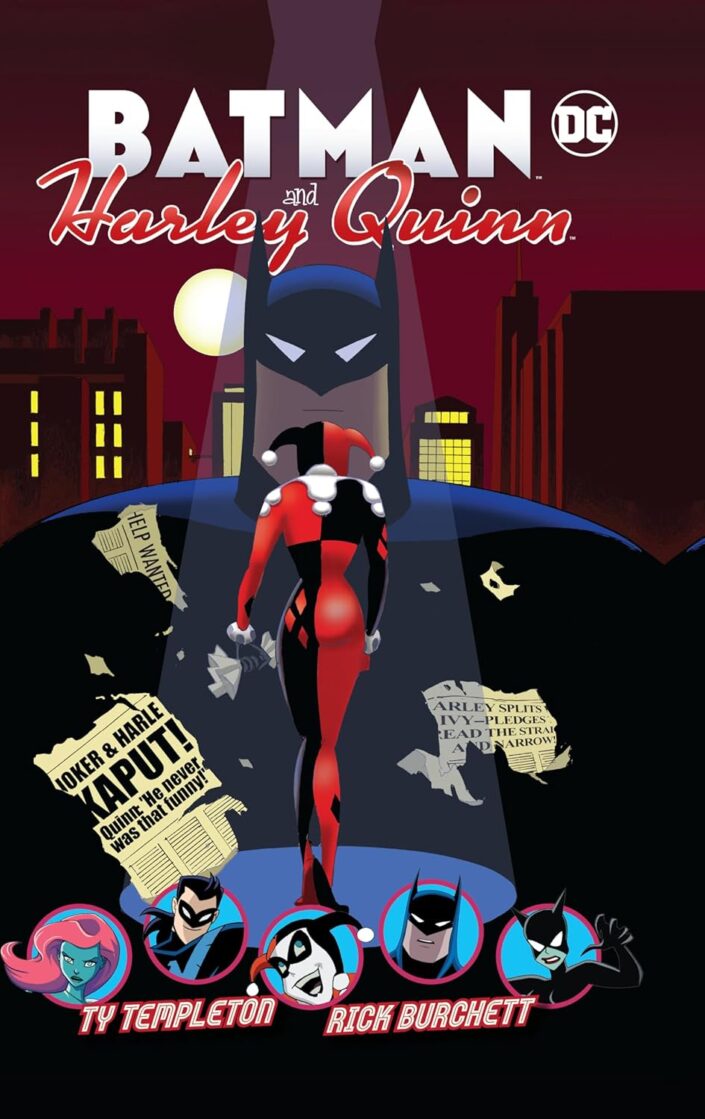
Published in 2017 as a three-issue miniseries, Harley Quinn and Batman revisits the dynamic between the Dark Knight and his recurring adversary within the DCAU-inspired comic continuity. Written by Ty Templeton with art by Rick Burchett, the series retains the stylized, animated-inspired designs and tone reminiscent of The New Batman Adventures.
A few months later, DC Comics published a sequel, Batman and Harley Quinn, another three-issue miniseries, this time written by Ty Templeton with art by Rick Burchett.
- Harley Quinn and Batman
Collects Batman and Harley Quinn chapters #1-7 and Harley Quinn and Batman chapters #1-5.
Then, Paul Dini and Jimmy Palmiotti united for Harley Loves Joker, a two-issue miniseries which worked as a sequel to the backstories published in Harley Quinn #17-26.
- Harley Loves Joker
Collects the backup stories from issues #17-25 of the Harley Quinn series and Harley Loves Joker #1-2.
Batman: The Adventures Continue (2020-2023)
Written by Paul Dini and Alan Burnett with art by Ty Templeton, Rick Burchett, and others, Batman: The Adventures Continue picks up where The New Batman/Superman Adventures ended, with the idea of filling in certain gaps in the original Batman: The Animated Series.
- Batman: The Adventures Continue Season One
Collects Batman: The Adventures Continue #1-8. - Batman: The Adventures Continue Season Two
Collects Batman: The Adventures Continue Season Two #1-7. - Batman: The Adventures Continue Season Three
Collects Batman: The Adventures Continue Season Three #1-7.
Justice League Infinity (2021-2022)
Another sequel series, Justice League Infinity is a seven-issue limited comic series that serves as a direct sequel to Justice League Unlimited, picking up shortly after the events of the animated series. The series was written by J.M. DeMatteis and James Tucker, with artwork by Ethen Beavers. In it, the Justice League confronts a mysterious being wandering the universe in search of its true purpose, leading to events that threaten not just their universe but multiple universes.
- Justice League Infinity
Collects Justice League Infinity #1-7.