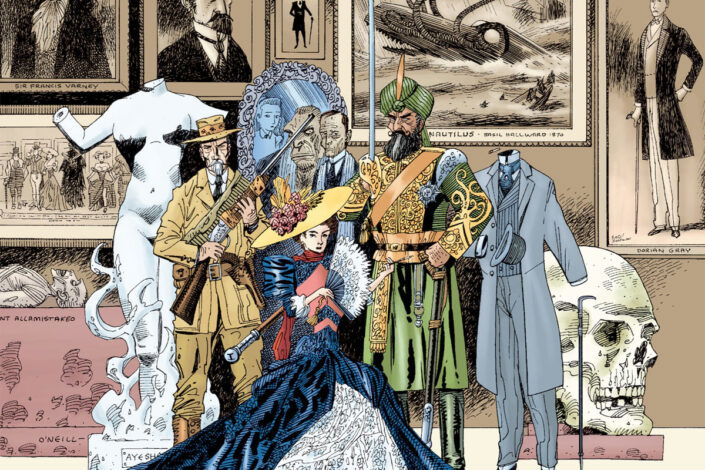
Written by Alan Moore and illustrated by Kevin O’Neill, the first volume of The League of Extraordinary Gentlemen comics was published in 1999 under America’s Best Comics. During the following two decades, more volumes would eventually be released by other publishers. There were limited series, spin-offs, and several prose and illustrated appendices, all forming a single, interlinked continuity.
The story begins in London in 1898, at the waning of the Victorian era. As the nineteenth century gives way to the twentieth, the British Empire stands at a crossroads. In response to threats beyond the reach of conventional authority, a covert team is assembled from figures drawn from nineteenth-century literature: adventurer Allan Quatermain; Mina Murray, survivor of Dracula; Captain Nemo of the Nautilus; Dr. Henry Jekyll and his monstrous alter ego Edward Hyde; and Hawley Griffin, the Invisible Man. United as the League of Extraordinary Gentlemen, they function as agents of imperial necessity, their abilities matched by deep personal flaws and conflicting ideologies.
Past the first volume, the story expands the scope beyond Victorian England, incorporating an ever-broadening tapestry of literary, pulp, and popular culture references spanning multiple centuries.
The League of Extraordinary Gentlemen Reading Order
While the last volume of The League of Extraordinary Gentlemen comics was published a few years ago, there is still no complete omnibus collection of the series. There was, however, a The League of Extraordinary Gentlemen Omnibus and what is called The Jubilee Edition released at the beginning of the 2010s, collecting the first two volumes of the series.
The League of Extraordinary Gentlemen Volume 1
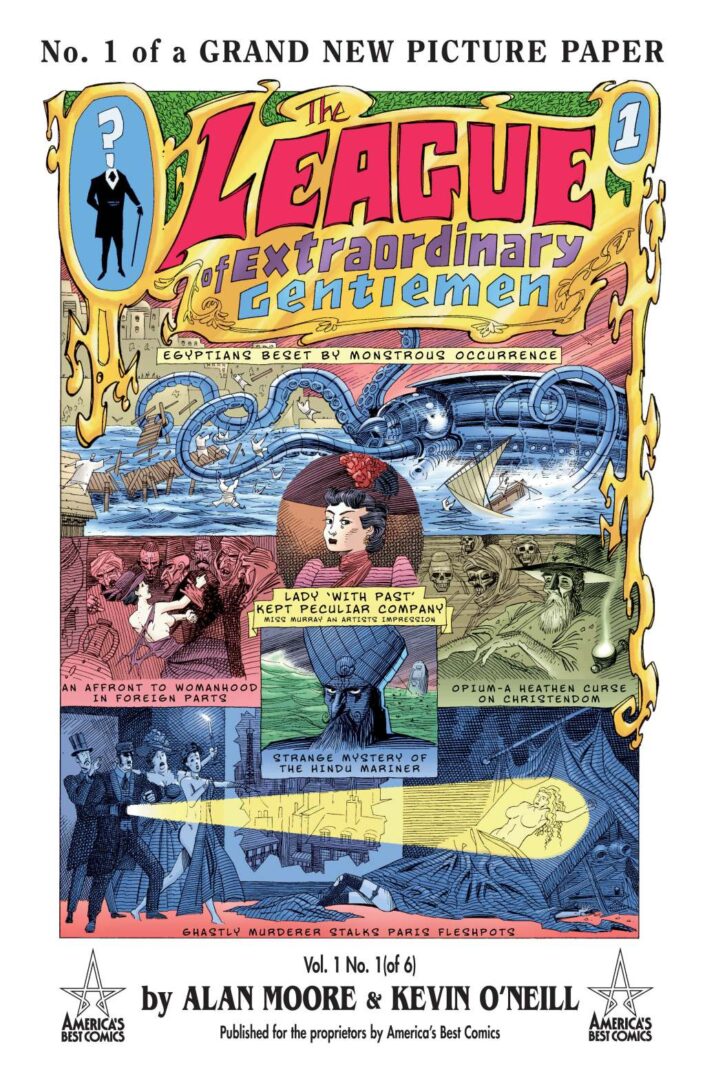
London, 1898. The Victorian era is nearing its end as the twentieth century looms, a moment marked by rapid technological progress, imperial confidence, and deep social anxiety. Beneath the appearance of order lies instability, as forces beyond the reach of conventional institutions threaten the British Empire. To meet these dangers, a secret initiative assembles an unconventional team: The League of Extraordinary Gentlemen.
- Allan Quatermain — An adventurer and big-game hunter created by H. Rider Haggard, first appearing in King Solomon’s Mines (1885).
- Mina Murray — A principal character from Bram Stoker’s Dracula (1897).
- Captain Nemo — The enigmatic captain of the Nautilus, originating in Jules Verne’s Twenty Thousand Leagues Under the Seas (1870) and The Mysterious Island (1874).
- Dr. Henry Jekyll / Edward Hyde — From Robert Louis Stevenson’s Strange Case of Dr Jekyll and Mr Hyde (1886).
- Hawley Griffin (The Invisible Man) — Created by H. G. Wells in The Invisible Man (1897).
Several other figures drawn from classic literature make notable appearances throughout the first volume, like Campion Bond (from the Bond stories by Sax Rohmer), Professor Cavor (from The First Men in the Moon by H. G. Wells), the criminal mastermind Fu Manchu (from Sax Rohmer’s Fu Manchu novels), Professor James Moriarty and Mycroft Holmes (from Arthur Conan Doyle’s Sherlock Holmes stories), and C. Auguste Dupin (from Edgar Allan Poe’s The Murders in the Rue Morgue).
- The League of Extraordinary Gentlemen, Vol. 1
Collects League of Extraordinary Gentlemen vol. 1 #1-6, and the Allan and the Sundered Veil back-issue story.
This first volume is also available in a new oversized hardcover Absolute Edition:
The League of Extraordinary Gentlemen Volume 2
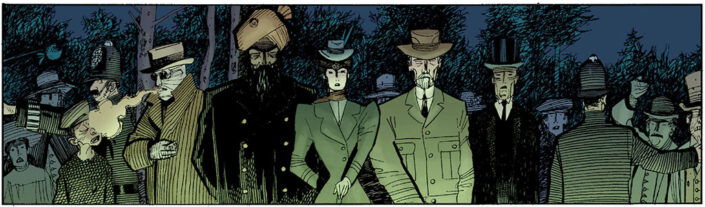
Volume II of The League of Extraordinary Gentlemen opens on Mars, where John Carter and Lieutenant Gullivar Jones have allied against the Martian ruling powers. When the invaders are driven from Mars and descend upon Earth, they begin their assault. As the invasion unfolds, the League fractures. Hawley Griffin abandons the group under the cover of invisibility. In response to the escalating crisis, Mycroft Holmes mobilizes Captain Nemo and Edward Hyde to defend the capital, deploying the Nautilus along London’s waterways, while Mina Murray and Allan Quatermain travel into the countryside to consult Dr. Moreau, whom British intelligence has tasked with developing a mysterious substance designated H-142.
The members of the League of Extraordinary Gentlemen are still Allan Quatermain, Dr. Henry Jekyll, Mina Murray, Captain Nemo, and Hawley Griffin. Once again, other figures from classic literature make notable appearances, especially from late nineteenth- and early twentieth-century science fiction. John Carter (from Edgar Rice Burroughs’s A Princess of Mars) and Lieutenant Gullivar Jones (from Edwin Lester Arnold’s Gullivar of Mars, 1905), and Edward “Teddy” Prendick and Dr. Moreau (from H. G. Wells’s The Island of Doctor Moreau).
- The League of Extraordinary Gentlemen, Vol.2
Collects League of Extraordinary Gentlemen vol. 2 #1-6, and The New Traveller’s Almanac back-issue story.
The League of Extraordinary Gentlemen: The Black Dossier
Not a traditional comic book, The League of Extraordinary Gentlemen: The Black Dossier is taking the story in a new direction. Set primarily in 1958, in a Britain governed by the authoritarian regime of “Big Brother,” the book follows an older Mina Murray and Allan Quatermain (now biologically rejuvenated) living as fugitives after the League has been declared obsolete and subversive. Their objective is to recover the Black Dossier, a classified file chronicling the full, hidden history of the League across centuries.
The Black Dossier functions as a hybrid work combining comics, prose fiction, faux-historical documents, illustrations, and pastiche. The dossier itself contains reports on previous incarnations of the League, tracing a secret continuity of fictional heroes, criminals, and mythic figures from antiquity through the twentieth century.
Mina Harker and Allan Quatermain are now immortal. New characters are introduced:
- James “Jimmy” Bond — A British intelligence agent from Ian Fleming’s famous 007.
- Emma Night — Better known as Emma Peel from the British 1960s adventure television series The Avengers.
- Hugo Drummond — A classic pulp adventurer created by H. C. McNeile.
- Orlando — The immortal protagonist shifting gender and identity through centuries from Virginia Woolf’s Orlando.
The Black Book expand its universe by including even more characters, like William George Bunter (from Charles Hamilton’s Greyfriars School stories), Prospero (from Shakespeare’s The Tempest), Fanny Hill (from John Cleland’s Fanny Hill), Galley-Wag (from P. G. Wodehouse’s school stories), Harry Lime (from Graham Greene’s The Third Man), and Bertie Wooster and Jeeves (from P. G. Wodehouse’s novels).
While not being a regular comic book, The Black Dossier is a key part of The League of Extraordinary Gentlemen narrative. It bridges the Victorian-focused volumes and the later Century trilogy.
- The League of Extraordinary Gentlemen: The Black Dossier
A mix of comic book and prose storytelling, this graphic novel even includes a 3-D section complete with custom 3-D glasses and much more.
The League of Extraordinary Gentlemen Volume 3: Century
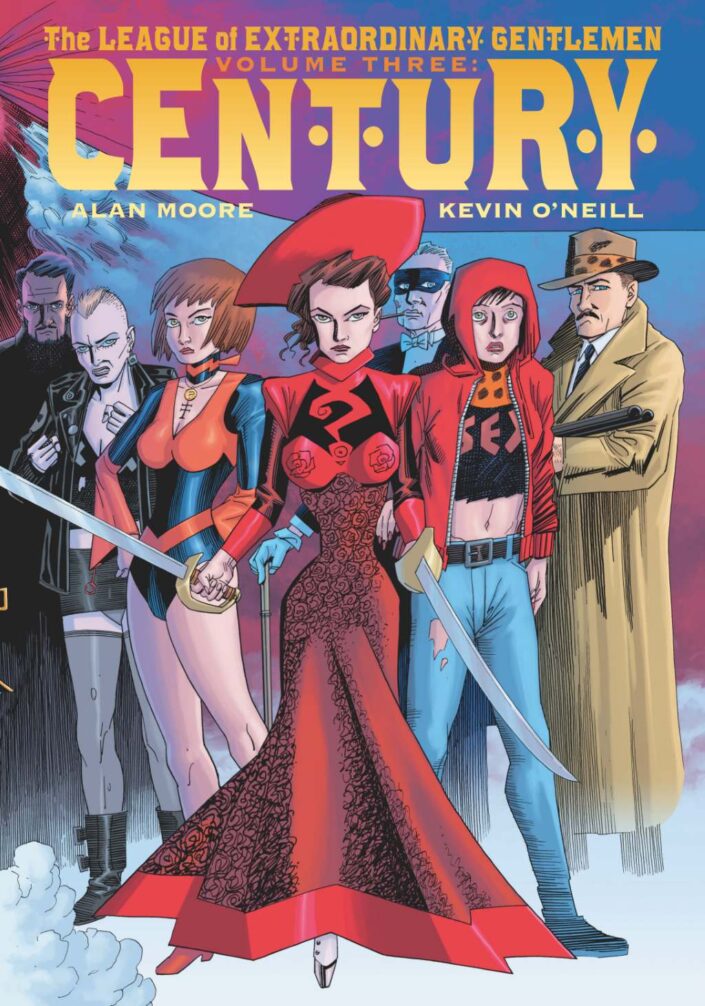
With the nineteenth century concluded amid the upheavals of Moriarty and the Martian invasion, Mina Murray now commands Britain’s Division of Military Intelligence, though the organization is weakened and in disarray. Alongside her lover Allan Quatermain, she has recruited new allies: the immortal and trans-gendered Orlando, the ghost-hunter Thomas Carnacki, and the gentleman thief A.J. Raffles, filling the gaps left by deceased or missing colleagues. Meanwhile, former associate Captain Nemo has retired to his Pacific island in isolated seclusion.
Century traces the League of Extraordinary Gentlemen’s struggle across a full hundred years, from 1910s occult parlours and crime-ridden wharves, through the mystical and psychedelic underworlds of 1969, to the socially and economically devastated streets of 2009.
The League is now comprised of Mina, Allan, Orlando, and two new members:
- Thomas Carnacki — The supernatural detective from William Hope Hodgson’s stories.
- A.J. Raffles — The gentleman thief created by E.W. Hornung (Raffles, 1898).
There are even more than usual secondary characters from pop culture, including ones that are not named (clearly for right issues) like Mary Poppins and Harry Potter. There is Simon Iff (from Aleister Crowley’s occult writings), Oliver Haddo (from W. Somerset Maugham’s The Magician), Andrew Norton (from H. G. Wells’s The Time Machine), Karswell Trelawney (from Dennis Wheatley’s The Devil Rides Out), Ishmael (from Herman Melville’s Moby-Dick), Suky Tawdry and MacHeath (from John Gay’s The Beggar’s Opera), The 14th Earl of Gurney (from Wodehouse’s school and comic stories), Basil Thomas (from the books of books by Geoffrey Willans and Ronald Searle), Vince Dakin (from the 1971 British gangster film Villain), Jack Carter (from the 1971 British gangster thriller film Get Carter), Kosmo Gallion (from the episode “Warlock” of television series The Avengers), Jerry Cornelius (from Michael Moorcock’s novels), Terner (the lead singer of the Purple Orchestra from the 1970 British crime drama Performance), Colonel Cuckoo (from the short story “Whatever Happened to Corporal Cuckoo?” by Gerald Kersh), and more.
- The League of Extraordinary Gentlemen, Vol. 3: Century
Collects Century 1910, Century 1969 & Century 2009.
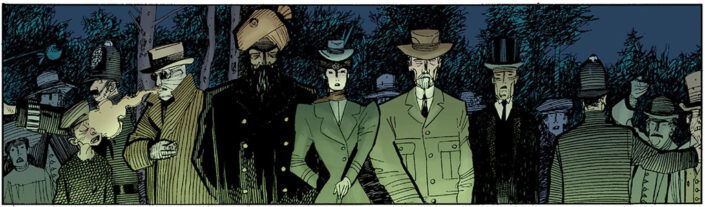
The League of Extraordinary Gentlemen: The Nemo Trilogy
Presented as a stand-alone hardcover spin-off from The League of Extraordinary Gentlemen, the Nemo trilogy follows Janni Dakkar, daughter of Captain Nemo, on her own extraordinary adventures. It consists of three volumes: Nemo: Heart of Ice, Nemo: The Roses of Berlin, and Nemo: River of Ghosts.
The story starts as we follow Janni to Antarctica, retracing her father’s fateful journey. After stealing a treasure from the powerful Ayesha, who exerts influence over Charles Foster Kane, Janni is pursued by Kane’s agents, including Frank Reade Jr., Jack Wright, and Tom Swift. The chase leads them to a mysterious pit connected to Yuggoth, a white giant, and an ice sphinx. The next two volumes see Janni fighting Nazis and journeying down the Amazon.
The main characters, like in other comics from The League of Extraordinary Gentlemen universe, come from pop culture:
- Janni Dakkar — The adventurous and cunning daughter of Captain Nemo.
- Tom Swift — The young inventor from Victor Appleton’s science fiction series.
- Broad Arrow Jack — The hero from the penny dreadful written by E. Harcourt Burrage.
- Adenoid Hynkel — A satirical version of Adolf Hitler from Charlie Chaplin’s The Great Dictator (1940).
- Ayesha — The immortal and powerful heroine/antagonist from H. Rider Haggard’s She (1887).
The Nemo Trilogy is composed of three hardcover graphic novels that were published separately and then made available in one package.
- Nemo: Heart of Ice
- Nemo: The Roses of Berlin
- Nemo: River of Ghosts
- The League of Extraordinary Gentlemen: The Nemo Trilogy
Collects Nemo: Heart of Ice, Nemo: The Roses of Berlin & Nemo: River of Ghosts.
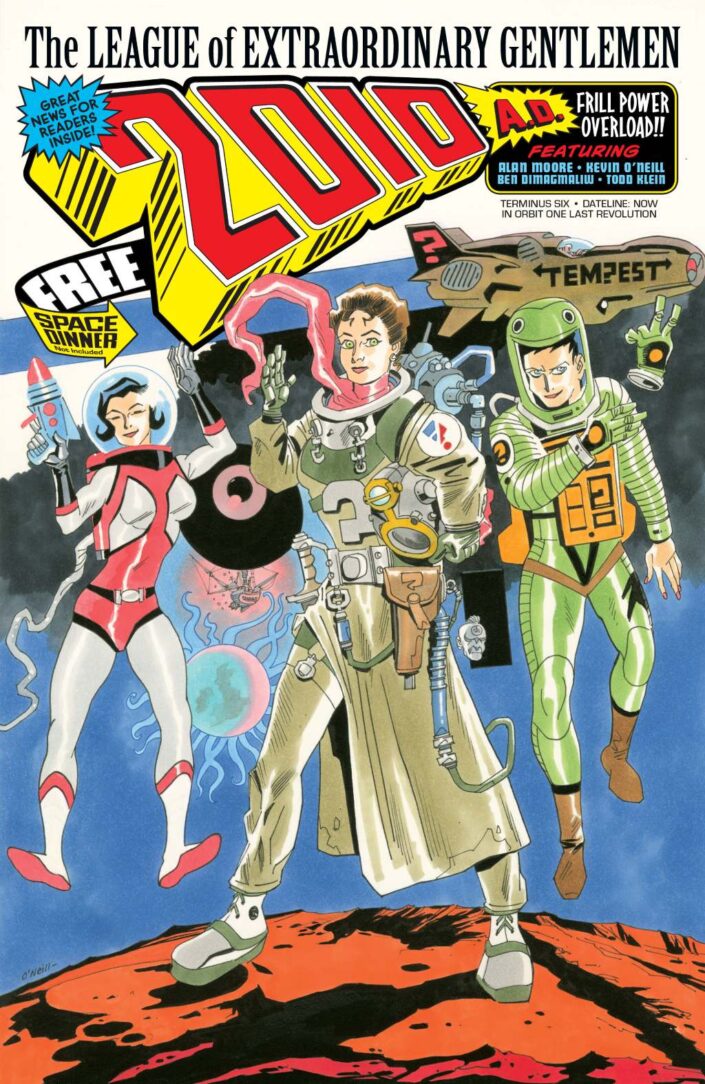
The League of Extraordinary Gentlemen, Volume 4: Tempest
The Tempest serves as the concluding chapter of The League of Extraordinary Gentlemen, opening simultaneously across multiple locations and eras: the panic-stricken headquarters of British Military Intelligence; the long-lost African city of Kor, ruled by the immortal Ayesha; and the domed citadel of “We” on the devastated Earth of the year 2996.
Mina Murray and the immortal Orlando take Emma Night to the Fire of Youth in Africa, restoring her youth and granting immortality; having abandoned MI5 and stolen the Black Dossier, they become fugitives and seek refuge with Jack Nemo on Lincoln Island. Meanwhile, the aging Jimmy Bond replaces Night as M, tortures her former associates to death, tracks the Fire of Youth, and destroys it with a nuclear strike before uncovering the League’s hidden history, including the Blazing World, which he also annihilates. Warned by Jack Nemo’s AI, the group divides, with Mina and Jack heading toward the Blazing World while Emma and Orlando return to London to confront Bond.
Mina Murray, Orlando, Emma Night, and Jimmy Bond return. The world of The League of Extraordinary Gentlemen welcomes:
- Captain Universe (Jim Logan) — A fictional British superhero who first appeared in Captain Universe (1954).
- Satin Astro & Burt Steele — A female Robin Hood and her sidekick, a space adventurer, from Whizzer Comics (1947).
- Electro Girl (Carol Flane) — A fictional British superhero with electrical powers from Whizzer Comics (1947).
- The Marsman — A crime fighter who first appeared in the British comic Marsman Comics (1948).
- Vull the Invisible — An invisible crook who appeared in the British comic Ranger in the mid-1930s.
- Gloriana — The Faerie Queene from the English epic poem “The Faerie Queene” (1590) by Edmund Spenser.
Like the first volumes, the fourth was originally published as a six-issue run.
- The League of Extraordinary Gentlemen, Vol. 4: Tempest
Collects League of Extraordinary Gentlemen vol. 4 #1-6.
Note: An earlier version of this guide appeared on our site in 2021. It has been completely refreshed and updated with more information, the latest release, and new pictures.