
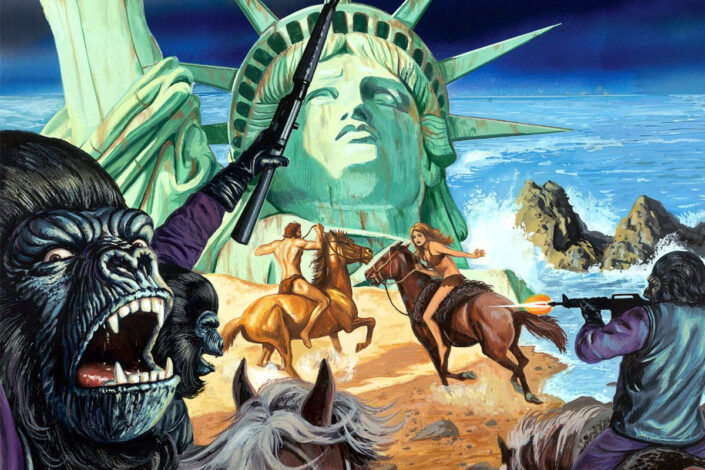
The Planet of the Apes franchise began in 1968 with the landmark film adaptation of Pierre Boulle’s novel “La Planète des singes.” It introduced us to a future in which intelligent apes dominate Earth and humanity has fallen into subjugation. Blending dystopian speculation, political allegory, and social satire, the film series and its associated live-action and animated TV shows, books, and comics have explored endless storytelling possibilities.
Because the franchise spans several distinct timelines and publishing eras, it may be difficult to follow everything. We are going to take a look at the Planet of the Apes comics by continuity and era.
From the early adaptations and original stories published by Marvel Comics in the 1970s to the modern, continuity-driven expansions by BOOM! Studios, the franchise has been reinterpreted across multiple eras. Some series adapt the original Planet of the Apes film cycle, others expand the reboot timeline launched by Rise of the Planet of the Apes, and several create standalone alternate continuities, including crossovers with properties like Green Lantern.
Planet of the Apes Comics Reading Order
Multiple publishers have explored multiple continuities: adaptations of the original film cycle, expansions of the reboot timeline, alternate futures, and crossover events.
In the article, we are going through the complete publication history, but here are the major eras:
- Marvel of the 70s: The Classic Era
- Malibu Comics: The “Forbidden Zone” Years (1990–1993)
- Boom! Studios: The Modern Revolution (2011–2023)
- The Marvel Return: The Present Timeline (2023–Present)
The Japanese Manga Adaptations
When it comes to Planet of the Apes stories in comic book form, the first ones came from Japan (where the film was titled “Saru no Wakusei“). The 1968 movie received two separate manga adaptations. The first, written and illustrated by Jôji Enami, was published in Bessatsu Bôken’Ô in April 1968. The second, illustrated by Minoru Kuroda, appeared in Tengoku Zôkan in June 1971.
The fifth and final movie in the original film series, Battle for the Planet of the Apes (1973), was also adapted into manga as “Saigo no Saru no Wakusei”, illustrated by Mitsuru Sugaya and published in a 1973 special issue of Weekly Shōnen Champion.
The Classic Era: Marvel of the 70s
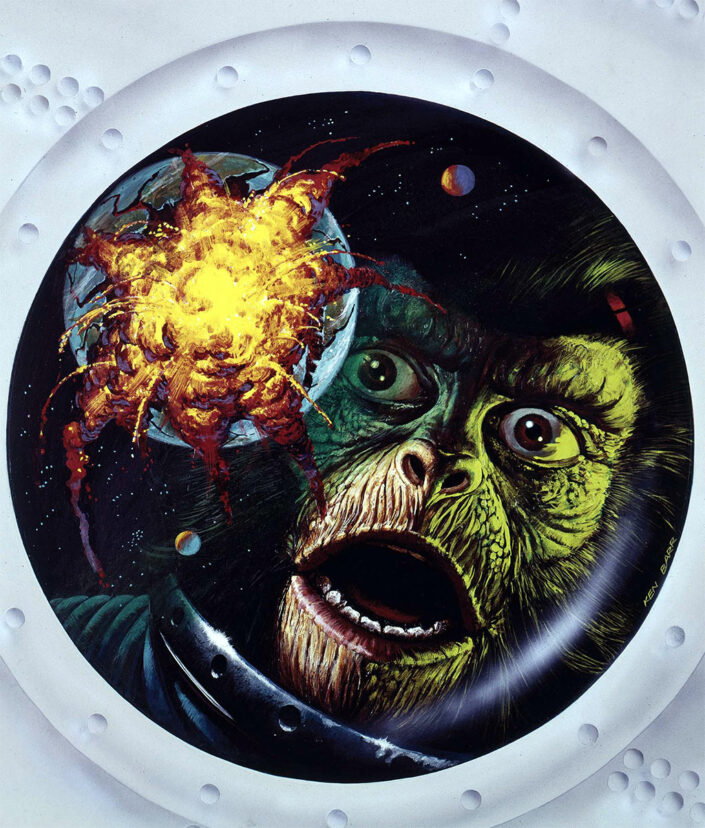
Published under the imprint “Curtis Magazines,” Marvel Comics put out a “Planet of the Apes” black-and-white magazine. It ran for twenty-nine issues from 1974 to 1977 and contained adaptations of all five movies from the original film series, but also original stories. Doug Moench and Gerry Conway were the main writers. Mike Esposito, Mike Ploog, George Tuska, and others provided the art.
In 1975, Marvel reprinted in color versions of the adaptations of the first two films under the title “Adventures on the Planet of the Apes.” This series ran for 11 issues and was recently collected in two versions: the hardcover omnibus and the paperback Epic Collection.
- Planet Of The Apes Adventures: The Original Marvel Years Omnibus
Collects Adventures in the Planet Of The Apes #1-11. - Planet Of The Apes Adventures Epic Collection: The Original Marvel Years
Collects Adventures in the Planet Of The Apes #1-11.
Before those reprints, Boom Studios! released hardcover B&W collected editions of stories from the Planet of the Apes Magazine under the title “Planet of the Apes Archives.” Since the license went back to Marvel, those books are now hard to find.
- Planet of the Apes Archive, Vol. 1: Terror on the Planet of the Apes
Collects the Terror on the Planet of the Apes storyline. - Planet of the Apes Archive, Vol. 2: Beast on the Planet of the Apes
Collects adaptation of Planet of the Apes, Beneath the Planet of the Apes, and the Adventures of Derek Zane. - Planet of the Apes Archive, Vol. 3: Quest for the Planet of the Apes
Collects adaptation of Escape from the Planet of the Apes, Conquest of the Planet of the Apes, and the story “Quest for the Planet of the Apes.” - Planet of the Apes Archive, Vol. 4: Evolution’s Nightmare
Collects adaptation of Battle for the Planet of the Apes, the “Future History Chronicles” stories, and the “Evolution’s Nightmare.”
International & Multimedia Adaptations (1975–1981)
During the mid-1970s, Planet of the Apes expanded beyond standard comic publishing into a variety of international and multimedia formats. In 1975, Power Records released book-and-record adaptations of four films from the original series, later compiling them into an audio-only LP (Conquest of the Planet of the Apes was the only one not adapted).
Between 1975 and 1977, Brown Watson published three UK hardcover annuals based on the television series. In Argentina, Editorial Mo.Pa.Sa. released seven original Spanish-language comics written by Jorge Claudio Morhain and Ricardo Barreiro, with art by Sergio Mulko and T. Toledo. And in 1978, the Filipino parody Planet op di Eyps began serialization in Pilipino FUNNY Komiks.
The “Forbidden Zone” Years: Malibu Comics (1990-1993)
During the early 1990s, Malibu Comics, through its Adventure Comics division, expanded the Planet of the Apes universe with a series of stories set after the events of the fifth and final installment in the original film series. There was a 24-issue monthly title that served as the backbone of this era, one-shots, annuals, and multiple miniseries.
Set two generations after the events of Battle for the Planet of the Apes and revolving around Caesar’s grandson, the Planet of the Apes comics series was written by Charles Marshall with art by Kent Burles, Barb Kaalberg, M.C. Wyman, Terry Pallot, and Peter Murphy. The main theme was the struggle of the liberated apes to integrate humans into their society.
- Planet of the Apes: Sins of the Father (one-shot set 30 years before the events of the “Planet of the Apes” movie)
- Planet of the Apes #1-12
- Ape Nation (4-issue miniseries, crossover with Alien Nation)
- Planet of the Apes #18, #21-24
- Planet of the Apes: Ape City #1-4 (miniseries)
- Planet of the Apes: Urchak’s Folly #1-4 (miniseries)
- Planet of the Apes #13-17
- A Day on the Planet of the Apes #1 (annual)
- Planet of the Apes: Blood of the Apes #1-2 (miniseries)
- Planet of the Apes #21
- Planet of the Apes: Blood of the Apes #3-4 (miniseries)
- Planet of the Apes: Forbidden Zone #1-4 (miniseries)
Credit to shaxper for his comprehensive timeline. Those stories have not been reprinted this century.
“The Chronicles of Ashlar”: Dark Horse Comics (2001)
Dark Horse Comics obtained the licence for Tim Burton’s Planet of the Apes and produced adaptations and sequels of this 2001 remake. As such, unlike the previously published comics, these are not linked to the original continuity.
The comic book adaptation of the movie was written by Scott Allie who also penned a serialized Comic Strip published in Dark Horse Extra with artists Eric Powell and Dan Jackson. This version is not about Taylor crashing on the Ape planet, but about astronaut Leo Davidson.
Then came The Human War miniseries from Ian Edginton, Paco Medina, and Juan Vlasco. Set a generation after the events of the film, it focuses on the Esau and Seneca characters who are attempting to fulfil the unrealised dream of achieving harmony between apes and humans.
- Planet of the Apes: The Human War
Collects Planet of the Apes: The Human War #1-3.
For a short while, Dark Horse published a monthly Planet of the Apes comic book series. There were two storylines that are set in the direct continuity of The Human War miniseries, picking up the story where it left off. The first was written by Ian Edginton, the second by Dan Abnett. Multiple artists worked on each issue, including Adrian Sibar and Norman Lee, Paco Medina and Juan Vlasco, Sanford Greene and Pop Mhan.
- Planet of the Apes: Old Gods
Collects Planet of the Apes (2001) #1-3. - Planet of the Apes: Blood Lines
Collects Planet of the Apes (2001) #4-6.

The Modern Revolution: Boom! Studios (2011-2023)
In 2011, Boom! Studios took over the Planet of the Apes comic book license as a new film series hit the screen. There were two timelines explored. One expanding the original lore, set in the 1968 timeline. One tied to the new prequel trilogy.
The “Classic” Expansion: New stories set in the 1968 timeline
Set before the events of the original 1968 Planet of the Apes and within the continuity of the first five films, this new series depicts Ape and Human societies at the height of a fragile golden age. Beneath the surface, dissent spreads through both populations, threatening the balance of power. When the revered Lawgiver is assassinated, tensions escalate toward open conflict. As suspicion and instability take hold, the question becomes whether the crime can be solved in time to prevent a war that could mark the beginning of the end for Apes and Humans alike.
Written by award-winning novelist Daryl Gregory, with art by Carlos Magno, this series is composed of 16 issues, an annual, and three special one-shots, and has been collected in one omnibus and in 5 trade paperbacks.
- Planet of the Apes Omnibus (2018)
Collects Planet of the Apes (2011) #1-16, Annual #1, Planet of the Apes Special #1, Planet of the Apes Spectacular #1, and Planet of the Apes Giant #1.
- Planet of the Apes Vol. 1: The Long War – Collects Planet of the Apes (2011) #1-4.
- Planet of the Apes Vol. 2: The Devil’s Pawn – Collects Planet of the Apes (2011) #5-8.
- Planet of the Apes Vol. 3: Children of Fire – Collects Planet of the Apes (2011) #9-12.
- Planet of the Apes Vol. 4: The Half Man – Collects Planet of the Apes (2011) #13-16, Planet of the Apes Annual #1.
- Planet of the Apes Vol. 5: The Utopians – Collects Planet of the Apes Special #1, Planet of the Apes Spectacular #1, and Planet of the Apes Giant #1.
Concurrently with Daryl Gregory’s Planet of the Apes series, but sharing no continuity with it, Boom! Studios also published multiple limited series exploring events leading up to the first Planet of the Apes film.
Now collected under the “After the Fall” banner, those stories were written and drawn by Corinna Bechko and Gabriel Hardman. This started with Betrayal of the Planet of the Apes, set approximately twenty years before the arrival of Taylor in the original 1968 film continuity. The series depicts Ape society during a period of structural transition: the traditional caste hierarchy is eroding, scientific inquiry is challenging long-standing religious taboos, and mute humans are regarded as animals, but are nonetheless permitted within the boundaries of the City. These shifts generate political and ideological instability. Opposition factions, resistant to reform, emerge in defense of orthodoxy, with some prepared to violate the Lawgiver’s central tenet, “Ape shall not kill Ape,” to arrest what they perceive as a dangerous march toward change.
After that came Exile on the Planet of the Apes, set 18 years before Planet of the Apes, and the 12-issue series Planet of the Apes: Cataclysm, set a decade later. Those stories were collected in one omnibus:
- Planet of the Apes: Before the Fall Omnibus
Collects Betrayal of the Planet of the Apes, Exile on the Planet of the Apes, Planet of the Apes: Cataclysm, and Planet of the Apes: The Scroll #1.
- Betrayal of the Planet of the Apes – Collects Betrayal of the Planet of the Apes #1-4.
- Exile on the Planet of the Apes – Collects Exile on the Planet of the Apes #1-4.
- Planet of the Apes: Cataclysm Vol. 1 – Collects Planet of the Apes: Cataclysm #1-4.
- Planet of the Apes: Cataclysm Vol. 2 – Collects Planet of the Apes: Cataclysm #5-8.
- Planet of the Apes: Cataclysm Vol. 3 – Collects Planet of the Apes: Cataclysm #9-12.
Coming from another creative team, writer David F. Walker and artist Chris Mooneyham, the 6-issue miniseries Planet of the Apes: Ursus is connected to the events of the original film (except the last issue set during the sequel), retelling the story from General Ursus’ point of view.
- Planet of the Apes: Ursus
Collects Planet of the Apes: Ursus #1-6.
Another type of story found its way on the comic pages. Planet of the Apes: Visionaries is not a new addition to the lore, but an adaptation of the original screenplays for Planet of the Apes by The Twilight Zone’s Rod Serling. It was famously heavily revised before filming. Writer Dana Gould and artist Chad Lewis used it to produce a graphic novel.
The Prequel Trilogy Era: Comics that tie into Rise, Dawn, and War for the Planet of the Apes.
When the movie Rise of the Planet of the Apes came out, Boom! Studios started publishing comics set around them, starting with a prelude to the film telling the story of Alpha and Bright Eyes, Caesar’s parents. A few years later, comics titled Dawn of the Planet of the Apes told a story set between the first two films, and War for the Planet of the Apes did the same, but for the period between movies two and three.
All of these comic book miniseries and one-shots have been collected in the After the Fall Omnibus.
- Planet of the Apes: After the Fall Omnibus
Collects Rise of the Planet of the Apes, Dawn of the Planet of the Apes: Contagion, Dawn of the Planet of the Apes, War for the Planet of the Apes, When Worlds Collide.
- Dawn of the Planet of the Apes Vol. 1 – Collects Dawn of the Planet of the Apes #1-6.
- Planet of the Apes: When Worlds Collide – Collects The Time of Man and The Simian Age.

The out-of-continuity Crossovers: Where Apes meet Green Lantern, Star Trek, and Kong.
One of the magic of comics is to allow unexpected connections between wildly different universes that have no business being mashed up together. During the years Boom! Studios exploited the Planet of the Apes license, multiple crossovers between sci-fi/fantasy franchises came to be. In association with Dark Horse Comics, Boom! Studios put out a crossover with Tarzan written by Tim Seeley and David F. Walker, with art by Fernando Dagnino. With IDW, Star Trek collided with the Ape world in a crossover by writer Scott Tipton and David Tipton, with artist Rachael Stott. DC Comics allowed the Green Lanterns to visit the Planet of the Apes in a miniseries by Justin Jordan and Barnaby Bagenda. And finally, Ryan Ferrier and Carlos Magno put the Kong on a trip to Skull Island with Cornelius and Zira.
- Tarzan on the Planet of the Apes
Collects Tarzan on the Planet of the Apes #1-5. - Star Trek/Planet of the Apes: The Primate Directive
Collects Star Trek/Planet of the Apes: The Primate Directive #1-5. - Planet of the Apes: Green Lantern
Collects Planet of the Apes: Green Lantern #1-6. - Kong on the Planet of the Apes
Collects Kong on the Planet of the Apes #1-6.
The Marvel Return (2023-Present)
Following Disney’s acquisition of 20th Century Studios, the Planet of the Apes franchise came back to Marvel Comics. Naturally, new comics began to be produced, starting with a story set between Rise and Dawn of the Planet of the Apes, written by David Walker and illustrated by Dave Wachter, before a Beware the Planet of the Apes and the Kingdom tie-in miniseries by Marc Guggenheim and Álvaro López featuring Cornelius, Zira, and Nova.
- Planet of the Apes: Fall of Man
Collects Planet of the Apes (2023) #1-5. - Beware the Planet of the Apes
Collects Beware the Planet of the Apes #1-4.
Writer Josh Trujillo and artist Andrea Di Vito introduced the Apes to Marvel’s first family in a 4-issue crossover miniseries.
- Planet of the Apes vs. Fantastic Four
Collects Planet of the Apes vs. Fantastic Four (2026) #1-4.