
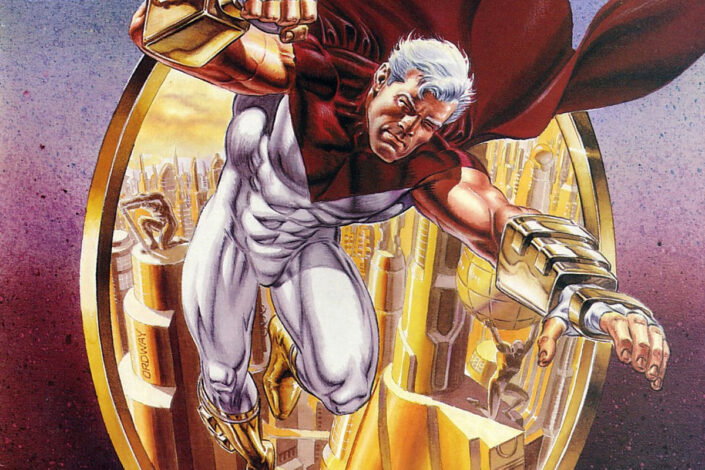
In 1992, Image Comics started a revolution in the publishing world. Rob Liefeld’s Youngblood was the first series launched and was a hit. The characters were derivatives of existing DC Comics ones, though. In a six-page backstory published in Youngblood #3, Liefeld, with writer/artist Brian Murray, introduced Supreme, an archetypal Superman who immediately got his own solo series.
Ethan Crane is Supreme. He can fly, has super strength, heat vision, ice breath, is invulnerable, can absorb energy, and has even more abilities. Due to the tone of the edgy comics Liefeld was producing, he was also a hyper-violent, distant, godlike figure who was above conventional human concerns. In fact, at one point, he considered himself a god. But when people usually talk about Supreme, they are referencing Alan Moore‘s run that started with issue #41. It was a complete reimagining of the character, a new start. Moore did whatever he wanted and shifted the tone of the book, making it a sort of apology for having influenced the comics world to go into darker territory.
Through the years, Supreme went to other imprints, other writers took over, miniseries were produced, and crossovers happened. If Moore’s run is still the only one discussed today, there are more Supreme stories out there. So, let’s try to navigate through publication history with a Supreme reading order.

Supreme Reading Order
Due to rights issues, Supreme comics have not been back in print for a while. Some have never been collected and may never be. As a result, unlike what we usually do at Comic Book Treasury, this reading guide focuses more on the issues than on the collected editions.
Rob Liefeld’s Supreme
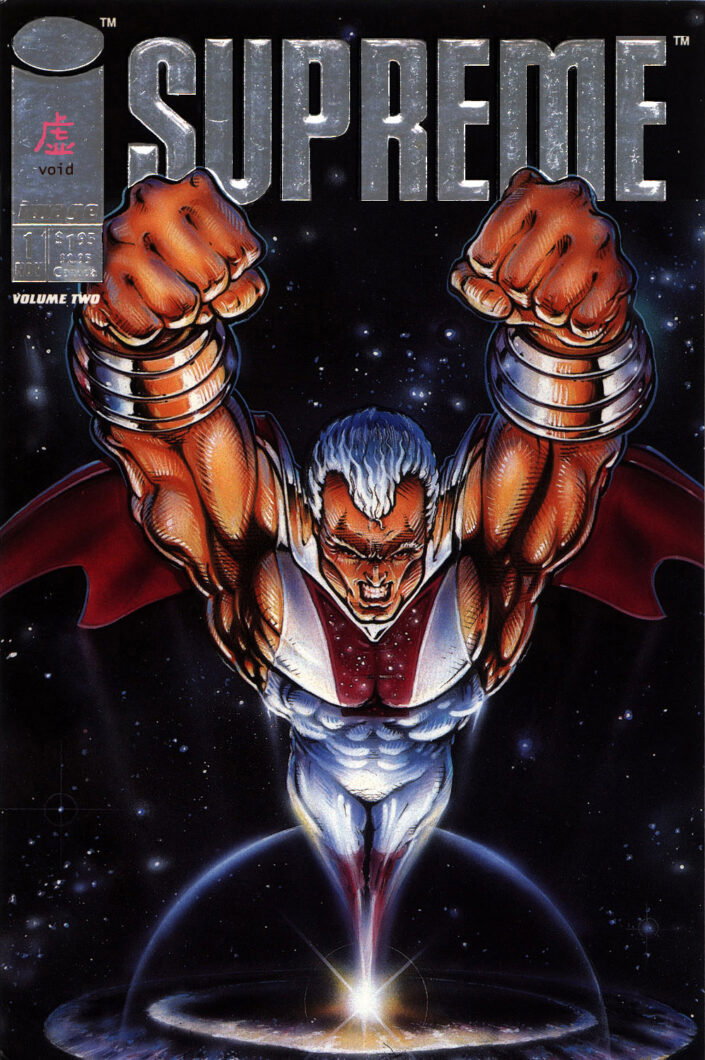
Launched in 1992 under the direction of Rob Liefeld, Supreme was Superman but filtered through the aggressive visual and tonal sensibilities that defined early Image Comics. Ethan Crane is introduced as a near-omnipotent figure whose presence operates on a global, often cosmic scale, with conflicts escalating into large-scale destruction rather than grounded interpersonal drama. Supreme was the most powerful.
From the beginning, like most of the Image Comics titles, Supreme suffered from delays. Rob Liefeld had to share creative duties on the book with multiple writers and artists, mainly Brian Murray, Eric Stephenson, Shawn McManus, Kurt Hathaway, Gary Carlson, Joe Bennett, Jim Valentino, and more.
The only trade paperback collecting stories from that era is Supreme Madness (which collects Supreme #12-18).
- Supreme #1-9
- Bloodstrike (1993) #5 – Supreme guest-starred in Bloodstrike, and took apart the team.
- Supreme #10 – The story in this issue takes place during Bloodstrike (1993) #9.
- Supreme #11 – This issue is part of the line-wide Extreme Prejudice crossover. You can just read this issue, but if you want the full event: Extreme Prejudice #0, Team Youngblood #7, Brigade #8, Bloodstrike #9, Supreme #11, Team Youngblood #8, Brigade #9, Bloodstrike #10.
- Supreme #12
- Supreme #25 – As part of the “Images of Tomorrow” publication initiative, some Image Comics titles jumped to issue #25 as a gimmick to give a preview of what’s to come. It’s not a case of a later issue you ned to read before, #25 was originally published between #12 and #13.
- Supreme #13-22 – There is a change of status quo following the Extreme Prejudice crossover.
- Supreme: Glory Days #1-2 – Around that time, the Glory Days miniseries was published, recounting the time Supreme took on the German army in the final days of WWII, before jumping back 50 years later.
- The Legend of Supreme #1-3 – Also during that period, in the 3-part miniseries Legend of Supreme, Maxine Winslow (see Supreme #5) explores Supreme’s past during World War II.
- Supreme #23 – Part of the Extreme Sacrifice crossover. You can skip the rest of the event, but if you want to read: Youngblood Strikefile #11, Extreme Sacrifice #1, Supreme #23, Bloodstrike #18, Brigade #16, NewMen #10, Team Youngblood #17, Prophet #10, Extreme Sacrifice #2.
- Supreme #24 – Epilogue to the Extreme Sacrifice story.
- Supreme #26-28 – Issue #25 was published earlier.
- Supreme #29/Prophet annual #1/Glory #5/Brigade #22/Supreme #30 – This is the Supreme Apocalypse crossover. One that is focused on Supreme who appeared in all the issues.
- Supreme #31
- Supreme Annual #1
- Supreme #0
- Supreme #32-34
- Supreme #35 – Part of the Extreme Destroyer crossover. Once again, you can skip the rest of the event, but if you want to read: Extreme Destroyer Prologue #1, Maximage #2, New Man #1, Youngblood (1995) #4, Glory (1995) #9, Knightstrike #1, Supreme #35, New Force #1, Extreme Destroyer Epilogue #1.
- Supreme #36-40 – These are the last issues of Supreme based on the original Rob Liefeld characterization.
Before jumping into Alan Moore’s Supreme, let’s note that two spin-off series were launched.
- Kid Supreme #1-3/Asylum #9 – Danny Fuller is the second Kid Supreme. He got superpowers after being caught in a fight between Supreme and Union.
- Lady Supreme #1-2/Asylum #10 – Chelsea Henry is the daughter of Supreme and Glory. She was born in the future, but travels back in time to fight alongside her family.
Alan Moore’s Supreme
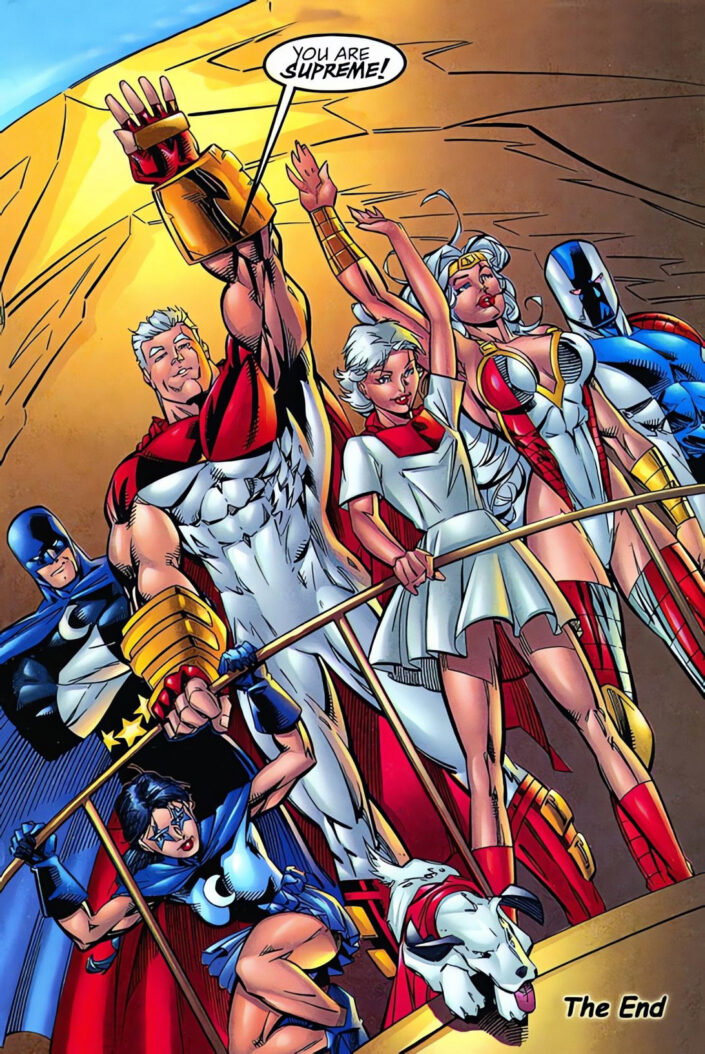
1996. Rob Liefeld was relaunching Captain America. Alan Moore was redefining Supreme. At that point, he had already regretted the influence he had on moving the comic books into a darker and more cynical world, and his new take on the Supreme character was to go the other way. He made it into a love letter to Superman from the 1960s. Moore threw away what the previous creative teams had done on the book and launched his good-guy Supreme with a new backstory that blatantly imitated Superman’s. It was seen as an homage, but Moore made Ethan Crane a cartoonist and got meta with the character (he even satirized himself in one issue).
As a result, this is a totally different Supreme, you don’t need to have read anything that came prior.
Moore wrote Supreme from issue #41 to #56, and then the miniseries “Supreme: The Return“, which was cancelled after 6 issues, leaving the series without a proper ending. Rick Veitch and Chris Sprouse were the main artists on the book.
In 2012, Supreme was relaunched, and the first issue, Supreme #63, was Moore’s final story (with art by Erik Larsen and Cory Hamscher), the conclusion of his work on the character.
- Supreme: The Story of the Year
Collects Supreme #41-52. - Supreme: The Return
Collects Supreme #53-56 and Supreme: The Return #1-6. - Supreme #63
It is clear that Moore’s work on Supreme paved the way for his Tom Strong universe, go check out our guide, it’s worth a read.
Supreme Returns
In 2006, Robert Kirkman wrote Supreme: Supreme Sacrifice #1 (published by Arcade Comics), but this led nowhere. The comeback was with Moore in 2012 and, after working on Supreme #63 with Moore, Erik Larsen had a short run (still with artist Cory Hamscher), from issue #64 to #68. His Supreme had to seek help from other Supreme from the multiverse (aka the Supremacy) and brought back Rob Liefeld’s version of the character. Omni-Man from Invincible also appeared.
In 2014, Warren Ellis and artist Tula Lotay worked on the 7-issue limited series “Supreme: Blue Rose.” In it, Ethan Crane has disappeared, and Diana Dane (Ethan’s Lois) tries to find him.
More recently, Supreme and his family appeared in the first three issues (mostly in issue #2) of the 2025 Youngblood, the relaunched series by Rob Liefeld.