
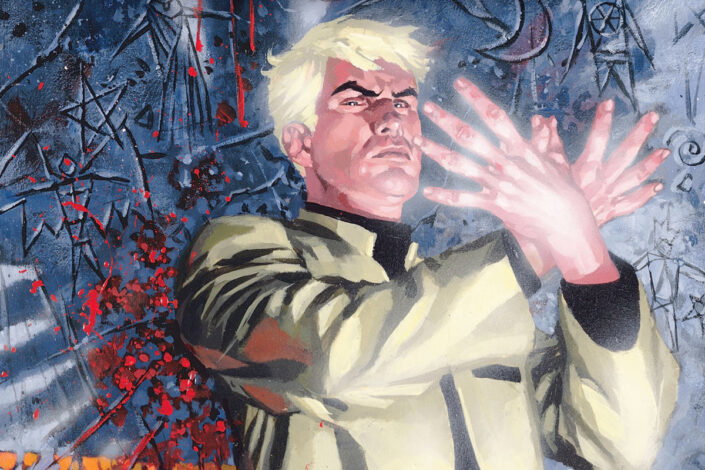
Once upon a time, in the Sandman Universe, Lucifer Morningstar was a fallen rebel archangel cast out of Heaven for leading the angels’ revolt. He was first introduced in The Sandman #4 in 1989 and became a supporting character in later issues. In the past, Lucifer had rebelled against the Kingdom of Heaven and ended up in what became Hell, until the day he decided to close shop. He retired to Earth and ran a bar named Lux with his mistress Mazikeen at his side. Rejecting God’s rule and morals, Lucifer set in motion a plan to truly gain his free will.
Through the years, Vertigo Comics launched spin-offs, expanding the universe beyond the central series, like with Dead Boy Detectives, The Dreaming, Books of Magic, and more. Mike Carey was eager to join the imprint and, especially, write in the Sandman Universe. He used to send his independent work, and this led one day to a phone call for a pitch to write a Lucifer miniseries in the spin-off anthology line “The Sandman Presents.” It was published in 1999. The Following year, Carey was back for what would become a 75-issue run (2000-2006), with artist Chris Weston at first, but Peter Gross soon came on board and drew most of the series.
If you are familiar with the character through the FOX/Netflix show (2016-2021), it’s important to know that the television adaptation starring actor Tom Ellis has almost nothing in common with the comic book series it is “based” on. It was note the only time the character was put on the screen. In the 2005 movie Constantine, he was played by Peter Stormare, and in the 2022 series adaptation of The Sandman, Gwendoline Christie played the part. But we are here to explore the comic books, so let’s jump into our complete Lucifer Reading Order!
DC Comics Lucifer: The Ultimate Reading Order and Collecting Guide
- Leaving Hell: The Sandman Years
- The Free Will Quest: Lucifer’s Solo series by Mike Carey (Must-Read)
- Solving the Deicide: Lucifer’s Comeback
- The New Sandman Universe: Dan Watters’s run

The Sandman Years: Lucifer’s Introduction
Lucifer Morningstar first appeared in The Sandman issue #4. In this issue, Dream of the Endless visited Hell to get back what was his, and he met with Lucifer. He discovered that he was forced to share his power after the Great Darkness’s return. A Triumvirate was formed, but Lucifer retained the majority of power. Next came the Season of the Mists storyline (starting with issue #21) in which Dream wanted to fix an old mistake. For that, he must visit Hell again, but he found Hell empty. Lucifer gave him the key and left for Perth, Australia. It’s the real starting point for the character. As we learn later (in issue #57), he didn’t stay there, he went to Los Angeles. If you only want the essential, read Season of Mists.
- The Sandman #4 collected in The Sandman: Preludes & Nocturnes.
- The Sandman #22-24, 28 collected in The Sandman: Season of Mists.
- The Sandman #57, 60, 64, 68, 69 in The Sandman: The Kindly Ones.
Collects The Sandman #57-69 and Vertigo Jam #1. The last short (and mostly optional) apparition of Lucifer Morningstar in The Sandman. That’s when we learn about his new life in Los Angeles.
Lucifer solo series by Mike Carey [Must-Read]
First, if you skip the Sandman comics, you will not have any difficulty going into the Lucifer comics by Mike Carey. The book was launched with The Sandman Presents: Lucifer miniseries in 1999, which gives you all you need to know about the character.
The series follows Lucifer Morningstar after he abandons his role as ruler of Hell, exploring themes of free will, predestination, creation, and rebellion through a story mixing mythology, religion, political intrigue, and cosmic fantasy. Over the seventy-five issues, the comic gradually develops its own mythology, which is distinct from The Sandman but still connected to the broader Vertigo universe. It introduces original characters, alternate realms, and metaphysical conflicts.
So, it’s self-contained. The best way to collect it all today is the Omnibus collection. But if you go through it via a Digital collection, once you’ve read the miniseries, you only have to know that the stand-alone Nirvana one-shot can be read when you want before the end of this first series (but before issue #20 is better). In the omnibus, it is set between issues #16 and #17.
- Lucifer Omnibus Vol. 1
Collects The Sandman Presents: Lucifer #1-3, Lucifer #1-35, and Lucifer: Nirvana #1. - Lucifer Omnibus Vol. 2
Collects Lucifer #36-75.

In 2013, DC Comics reprinted the whole series in a collection of 5 large paperbacks:
- Lucifer: Book One
Collects The Sandman Presents: Lucifer #1-3, Lucifer #1-13. - Lucifer: Book Two
Collects Lucifer #14-28, and Lucifer: Nirvana #1. - Lucifer: Book Three
Collects Lucifer #29-45. - Lucifer: Book Four
Collects Lucifer #46-61. - Lucifer: Book Five
Collects Lucifer #62-75.
Harder to find nowadays, the original paperback collection was composed of 11 books.
- Lucifer: Devil in the Gateway (Collects The Sandman Presents: Lucifer #1-3 & Lucifer #1-4)
- Lucifer: Children and Monsters (Collects Lucifer #5-13)
- Lucifer: A Dalliance with the Damned (Collects Lucifer #14-20)
- Lucifer: The Divine Comedy (Collects Lucifer #21-28)
- Lucifer: Inferno (Collects Lucifer #29-35)
- Lucifer: Mansions of the Silence (Collects Lucifer #36-41)
- Lucifer: Exodus (Collects Lucifer #42-44 & #46-49)
- Lucifer: The Wolf Beneath the Tree (Collects Lucifer #45 & #50-54)
- Lucifer: Crux (Collects Lucifer #55-61)
- Lucifer: Morningstar (Collects Lucifer #62-69)
- Lucifer: Evensong (Collects Lucifer #70-75, and Lucifer: Nirvana #1)
Lucifer’s Comeback: The Holly Black Series
The first Lucifer series ended in August 2006, effectively concluding the story that had grown out of The Sandman. Lucifer Morningstar later appeared in DC’s New 52 continuity, most notably in Demon Knights and other supernatural titles, but this version was largely disconnected from the Vertigo incarnation.
With the Lucifer television adaptation on the horizon, Vertigo relaunched the character in a new ongoing series in 2015, written by Holly Black with artwork by Lee Garbett. The series reintroduced Lucifer closer to his original Vertigo characterization, but it was a new entry point for readers. It all begins with God dead and the archangel Gabriel accusing Lucifer of His murder. Although Lucifer had both motive and opportunity, he claims innocence and sets out to uncover the real killer. Gabriel offers him a path back to Silver City if he can solve the mystery and deliver the true culprit, setting the stage for a supernatural detective story built around celestial politics, manipulation, and divine succession.
- Lucifer: Cold Heaven
Collects Lucifer #1-6. - Lucifer: Father Lucifer
Collects Lucifer #7-12. - Lucifer: Blood in the Streets
Collects Lucifer #13-19.
The New Sandman Universe: The Dan Watters Series
With the launch of the Sandman Universe line published under DC Black Label, Lucifer also received a new ongoing series in 2018, written by Dan Watters with art by Max and Sebastián Fiumara. The story begins with the former ruler of Hell missing and presumed gone, reduced instead to a blind, crippled old man trapped in a small town where reality constantly shifts and sinister forces manipulate events around him. Stripped of his memories, power, and identity, Lucifer must uncover how he arrived there while searching for his child, the only being capable of preventing the end of the world.

- Lucifer: The Infernal Comedy
Collects Lucifer #1-6; The Sandman Universe #1. - Lucifer: The Divine Tragedy
Collects Lucifer #7-13. - Lucifer: The Wild Hunt
Collects Lucifer #14-19. - Lucifer: The Devil at Heart
Collects Lucifer #20-24.
For a broader overview of the Sandman mythos and its related titles, see the Sandman Reading Order.
Reading digitally?
Check out Lucifer on DC Universe Infinite or Amazon / Kindle.
Note: An earlier version of this guide appeared on our site in 2022. It has been completely refreshed and updated with new pictures.
I actually have a question, is there anything that happens between Lucifer: Blood on the Streets and Lucifer: Infernal Comedy? Seems I might have missed a lot, like why doesn’t Lucifer have his wings and since when is Raguel the voice of Heaven? Also what happened to Gaudium, Spera and Elaine?
Hi Glen,
In terms of continuity, things are a bit muddy. Here’s a quote from writer Dan Watters:
“Because this is The Sandman Universe, we wanted to go back to The Sandman and the roots of the character,” Watters tells EW. “Lucifer has had these amazing long runs by Mike Carey and Holly Black, and it’s got this hugely successful TV show, so it’s trying to balance a version of him that will appeal to everyone who loves this character, but also doesn’t require you to have read a bunch of books or three seasons of a TV show. We were very much looking back to Sandman and using that as our primary source material.”
Some people even place it chronologically after Sandman but before Carey’s run, though it does not fit perfectly.
I think it’s closer to a take on the character rooted primarily in Sandman. Watters chose to go back more directly to the Sandman version of Lucifer while still drawing from previous stories without strictly following their continuity.
You can read more about Dan Watters’s approach on on Retcon Punch, where he provided more information on his first issue.