Skip to content

Fabien

Co-founder of Comic Book Treasury, your Hellboy Specialist and the man behind the Batman Modern Age and the Amazing Spider-Man Guides.

Nubia Reading Order (Wonder Woman)

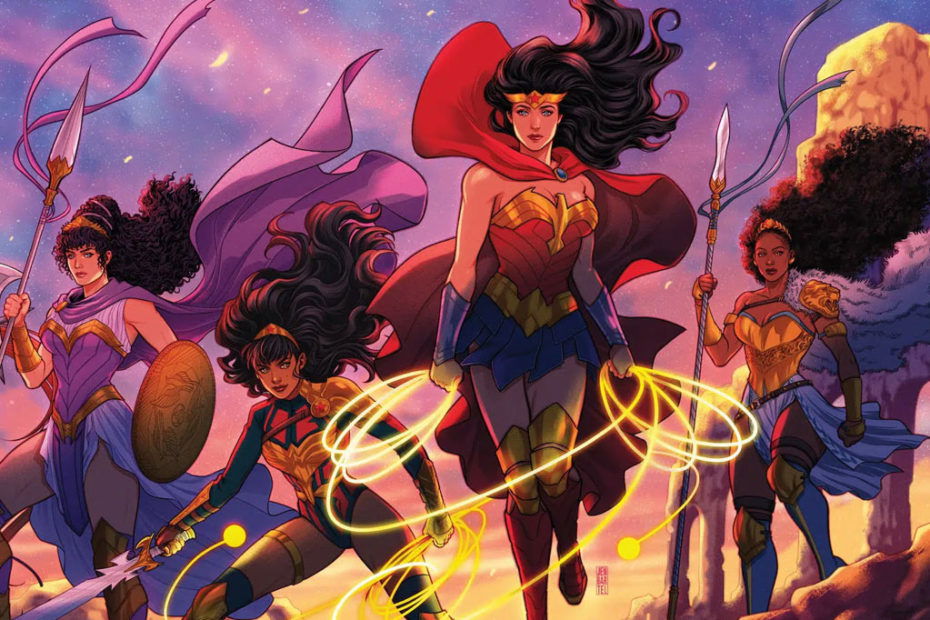
Introduced in 1973 in Wonder Woman #204, Nubia was created by writer Robert Kanigher and artist Don Heck. She is an Amazon, and DC Comics’ first Black woman superhero.

At first, Nubia was Wonder Woman‘s long-lost fraternal twin–she was raised by Mars the god of war as his weapon of destruction against the Amazons. Mars’ plan failed and Nubia only made a few appearances after that, then disappeared for 20 years!

When reintroduced during the Post-Crisis/Modern Age era of the DC Universe in Wonder Woman (vol. 2) Annual #8 in 1999, she was renamed Nu’Bia and was charged to guard “Doom’s Doorway” a very long time ago. So long in fact that the Themyscirian Amazons assumed she had perished. It was a short comeback.

But now in the Infinite Frontier era, after appearing in Future State: Immortal Wonder Woman, Nubia is fully back. Reintroduced as an Amazonian champion tasked with guarding Doom’s Doorway, Nubia shortly became Queen of Amazons and started sharing the title of Wonder Woman with Diana.

Read More »Nubia Reading Order (Wonder Woman)

Revenge of the Brood Reading Order, The X-Men and Captain Marvel Crossover

Back in the Chris Claremont days, Carol Danvers and the X-Men fought alongside each other in the original Brood Saga, a famous story that ended with Carol becoming Binary, and the X-Men making sacrifices.

The Broods are back for a double-story arc, “Revenge of the Brood” and “Lord of the Brood.” Captain Marvel is joined once again by the X-Men to fight the parasitic predators known as the Brood. They plan to infect the cosmos and the heroes must stop them.

Here is how Marvel officially introduces the stories:

In “Lord of the Brood,” the X-Men get a distress call from deep space and find that the galaxy’s Brood problem is not as solved as they’d thought! When the X-Men’s close friend Broo became the Brood King, he gained the ability to control the savage alien race he was both a part of and so different from. Now he is experiencing his own nightmare scenario—the Brood are killing his friends, and there is nothing he can do to stop it! Rogue Brood factions have begun running wild, and it’s up to the X-Men to get to the bottom of why!

In “Revenge of the Brood,” Carol Danvers is on an X-press elevator to her own personal hell! And the Brood Empress is determined to ensure the Captain and all of her friends make it to their destination. Rescuing their team and getting out alive has always been the goal, but the odds are more deeply stacked against her team than Carol can even imagine. Overwhelmed and trapped in the Brood’s backyard, Captain Marvel and her team are forced to sacrifice one of their own. But the Brood let Carol through their clutches once before, and in so doing, created one of their worst enemies. They won’t make that mistake again. 

This Captain Marvel/X-Men epic cosmic story is coming from Kelly Thompson, writer of Captain Marvel, with art by Juan Frigeri, and Gerry Duggan, writer of X-Men, with art by Stefano Caselli.

Read More »Revenge of the Brood Reading Order, The X-Men and Captain Marvel Crossover

X-Men Sins of Sinister Reading Order, a Marvel crossover event

Things never get easy for the X-Men. Right after A.X.E: Judgment Day and Dark Web, the Mutants are thrown into another crossover event, Sins of Sinister. This time, however, it’s an X-Men-only crossover.

The tagline is: “From his vaunted position on the Quiet Council of Krakoa, Mister Sinister has plotted and schemed. Now, at last, his plans come to fruition beyond his wildest dreams … and his darkest nightmares! Can the X-Men survive the experience? Can anyone?”

If we are to believe Marvel, Sins of Sinister is set in “a horror timeline that makes Age of Apocalypse look like the X-Men Swimsuit Special.” This story takes the Marvel Universe further and further into a dark future, dramatically escalating the stakes with each startling time jump. 10 Years … 100 Years … 1000 Years…

This crossover could be confusing because three current series are renamed for the occasion Immortal X-Men, X-Men Red, and Legion of X are—respectively—replaced by the limited series Immoral X-Men, Storm & The Brotherhood of Mutants, and Nightcrawlers.

Current X-Men writers Kieron Gillen, Al Ewing, and Si Spurrier are in charge of writing the new titles, joined by artists Paco Medina, Andrea Di Vito, and Alessandro Vitti.

Read More »X-Men Sins of Sinister Reading Order, a Marvel crossover event

Books of Magic Reading Order, The Adventures of Tim Hunter

Launched in 1991 by Vertigo with a miniseries, The Books of Magic is a creation of Neil Gaiman (with artists John Bolton, Scott Hampton, Charles Vess, and Paul Johnson). Contrary to some beliefs, it was not developed as a spin-off of The Sandman, even if the Endless appeared in it. DC Comics commissioned it as a way to highlight the already existing mystical characters in its universe.

The original miniseries introduced us to Timothy Hunter, a twelve-year-old boy who could be the most powerful magician in the world (a character inspired by T. H. White’s The Once and Future King and other classic fantasy stories). The question is: does he really want to be? To find the answer, Tim goes on a trip through the magical world, guided by John Constantine, Phantom Stranger, Mister E, and Doctor Occult, a group of magicians (aka the Trenchcoat Brigade). They want to aid Timothy in his decision.

Once the original Books of Magic miniseries concluded, the story continued with an ongoing 75-issue series written by John Ney Rieber (who penned the first 50 issues) and illustrated by Gary Amaro, Peter Gross, and Peter Snejbjerg. We reconnected with Tim when an enigmatic man named Tamlin decided that he was the key to saving the dying world of Faerie. But exactly how is Tim supposed to do that? And who is Tamlin? Read the book to discover the answers!

After that, Tim Hunter went through what most DC Comics characters have to deal with, from relaunches to alternate versions. He grew up, then later came back to being a 12-year-old boy. It’s a magical life after all. 

Read More »Books of Magic Reading Order, The Adventures of Tim Hunter

Who is Kraven the Hunter?

  • by

Spider-Man’s rogues’ gallery is composed of animal-themed characters like the Vulture, Doctor Octopus, the Lizard, the Scorpion, and plenty more, but also of people who altered—voluntarily or not—their bodies to become super-powered or who built some kind of devices to commit crimes like Sandman, Electro, Shocker, Hammerhead, Hydro-man, and of course, the Green Goblin.

Kraven the Hunter found its place in the middle of that. Created by writer Stan Lee and artist Steve Ditko in the pages of The Amazing Spider-Man #15 (see our Spider-Man Reading Order to find the story), Kraven came to New York wanting to hunt Spider-Man. This Russian is after “the most dangerous game.”—like another famous fictional Russian big game hunter, General Zaroff.

Read More »Who is Kraven the Hunter?

Reckless: Ed Brubaker and Sean Phillips’ Pulp Graphic Novel Series

  • by

At this point, when it comes to crime comics, Ed Brubaker and Sean Phillips’s comics have eclipsed David Lapham’s (Stray Bullets). If you talk about the genre, you irremediably think about Criminal, then comes other favorites like The Fade Out, Kill or be Killed, Fatale… 

With the award-winning Pulp, the duo confirmed that they don’t even need to connect their work to Criminal anymore—like with My Heroes Have Always Been Junkies—or to another series to find their audiences in a different format. They became the brand. Everything they try is basically a winner.

Reckless doesn’t contradict that. It is a new crime series, for sure, but the creative team decided to try a different publication approach. Each story is self-contained and collected in one 144-page hardcover graphic novel.

It’s like reading a good old pulp novel, but with Brubaker’s writing, Sean Phillips’s pencils, and Jacob Phillips’s colors, the result could almost qualify as a reinvention of the genre by the form—published by Image Comics.

Read More »Reckless: Ed Brubaker and Sean Phillips’ Pulp Graphic Novel Series

Batman White Knight Reading Order, exploring the Murphyverse

  • by

Launched in 2017 with the book Batman: White Knight, The Murphyverse is a universe created by Sean Gordon Murphy (Punk Rock Jesus, The Wake) and published under the DC Black Label imprint.

As the imprint suggests, this is not a series set within the DC continuity—it could be considered an Elseworlds series. The first book introduced us to a world where the Joker is cured of his insanity and homicidal tendencies. Now a politician under his real name of Jack Napier, The Joker sets about trying to right his wrongs. First, he plans to reconcile with Harley Quinn, and then he’ll try to save the city from the one person he thinks is truly Gotham City’s greatest villain: Batman!

The success of Batman: White Knight was massive, and the trade paperback quickly became a best-seller (it has since been republished in multiple formats). A sequel was commissioned, Batman: Curse of the White Knight.

This second limited series confirmed the popularity of this alternate version of Batman. This prompted DC Comics to give Sean Murphy his own line of books to be published under its Black Label imprint. The Murphyverse was born.

Read More »Batman White Knight Reading Order, exploring the Murphyverse

Iron Fist Reading Order (Danny Rand and Lin Lie)

  • by

In the early 1970s, Marvel Comics was quick to respond to cultural trends sweeping across America. With Blaxploitation cinema captivating audiences, Marvel introduced Luke Cage, Hero for Hire in 1972—the first African-American superhero to headline his own comic. Simultaneously, martial arts were booming in popularity, thanks in part to Bruce Lee’s rise and the influx of kung fu films from Hong Kong. Marvel’s answer to this new craze was the creation of Iron Fist.

Debuting in Marvel Premiere #15 in May 1974, Iron Fist was the creation of writer Roy Thomas and artist Gil Kane. Thomas, inspired by the martial arts films he and others at Marvel were watching at the time, crafted a character who blended the mysticism of Eastern legends with the action-packed energy of superhero comics. It’s worth noting that Shang-Chi, another Marvel martial artist influenced directly by Bruce Lee, had already launched in Special Marvel Edition #15 in 1973.

Iron Fist’s origin begins with young Daniel Rand, who, after witnessing his parents’ deaths during an expedition in the Himalayas, is taken in by the mystical city of K’un-Lun. There, he trains for a decade in martial arts and gains the power of the Iron Fist by defeating the dragon Shou-Lao the Undying.

Armed with superhuman chi and unmatched fighting skills, Rand returns to the Western world to avenge his parents. Though his solo series was short-lived, he gained new life when he teamed up with Luke Cage in the popular Power Man and Iron Fist series, turning them into Marvel’s go-to street-level duo.

After a brief “death” and resurrection in the ’90s, Iron Fist starred in acclaimed runs like The Immortal Iron Fist, which expanded his mythology and introduced a long line of past Iron Fists. Most recently, in 2022, the Iron Fist mantle was passed to Lin Lie, formerly known as Sword Master. With Danny Rand having lost the power of the Iron Fist, he now serves as a mentor to Lin, showing that while the torch has been passed, Rand’s journey is far from over.

Iron Fist has also entered the mainstream thanks to the Marvel Cinematic Universe. Portrayed by Finn Jones, Danny Rand appeared in the Netflix series Iron Fist, The Defenders, and the second season of Luke Cage. Though the show received mixed reviews, it brought renewed attention to the character and introduced Iron Fist to a new generation of fans.

Read More »Iron Fist Reading Order (Danny Rand and Lin Lie)

Who Is Tom Strong? Exploring the World of Alan Moore’s Golden Age Superhero

  • by

In 1999, Alan Moore launched America’s Best Comics, an imprint of WildStorm, still at Image Comics at that time. The idea was to develop a line of comics partly based on the 1940s Golden Age of comic books, partly motivated by Alan Moore’s passion for magic. Today, the most famous comics series from the imprint is The League of Extraordinary Gentlemen (Top Shelf and Knockabout Comics later published the series), but Tom Strong became the most developed universe.

Created by Alan Moore and artist Chris Sprouse, Tom Strong is a “science hero” who, with his wife Dhalua, his daughter Tesla, the enhanced ape King Solomon, and his robotic valet, Pneuman, fought science criminals and other supernatural/paranormal dangers for decades, but also at different times, worlds, and realms.

Tom Strong was born on the fictional West Indian island of Attabar Teru. There, his scientist parents placed him in a high-gravity chamber and provided him with an intensive education. Additionally, he grew up eating a root used by the island’s natives for health and longevity. When he got out, he was stronger, faster, more intelligent, and healthier than the average human being. He became an adult and married Dhalua, the daughter of Attabar Teru’s Chief Omotu. Together, they relocated to Millennium City and had a daughter named Tesla.

In the civilized world, Tom Strong became a science hero who fought masked “science villains” like Paul Saveen, the Nazi Ingrid Weiss, the mechanical-molecular megalomaniac Modular Man, Aztecs from an alternate Earth, and more.

Read More »Who Is Tom Strong? Exploring the World of Alan Moore’s Golden Age Superhero

Animal Man Reading Order

  • by

Buddy Baker aka Animal Man is a DC Comics superhero created by writer Dave Wood and artist Carmine Infantino in the pages of Strange Adventures #180 (September 1965) who has the ability to temporarily borrow the abilities of animals—he gained them after encountering a spaceship that blew up, infusing him with radiation.

For a long time, he was considered a second-rate superhero and didn’t really appear in a lot of books between the 1960s and the 1980s. Everything changed after the Crisis on Infinite Earths event when DC started to use British writers to revive old almost forgotten properties. That’s when Scottish writer Grant Morrison came on board. He reintroduced Buddy Baker in what was thought as a four-issue limited series, but its success led to a change and it became an ongoing series.

At that point, we met Buddy who is married to his high school sweetheart, Ellen, a storyboard artist. They have two children, Cliff and Maxine, and live in a suburban area outside of San Diego. As Animal Man, Buddy found his way by progressively becoming an animal rights activist, an environmentalist, and a vegetarian.

Animal Man profile was boosted by the success of the series and the character even briefly became a member of Justice League Europe. Once Morrison concluded his run, Peter Milligan took over, then Tom Veitch and Steve Dillon, and Jamie Delano and Steve Pugh, all exploring different aspects of the hero, from his stuntman past to the origin of his powers.

The story of Buddy changed when he was killed to be resurrected as the “Red” (like the “Green” of Swamp Thing, but for animals!) in the Vertigo Line for mature readers. After that, he occasionally made cameos in the regular DC Universe, including during the Infinite Crisis and 52.

After the New 52 relaunch, he made a comeback and later joined again with the JLA. During the Rebirth era, he also worked with the Justice League, but he never went on to become a major superhero.

Read More »Animal Man Reading Order