Skip to content

Fabien

Groot Reading Order

A well-known member of the Guardians of the Galaxy, Groot didn’t start out as a hero, but as a villainous alien intent on capturing humans for experimentation. He first appeared in Tales to Astonish #13 (November 1960), created by writer Stan Lee, artist Jack Kirby and scripter Larry Lieber. Of course, this is not the Groot we know today.

In 2006, he was reimagined as a heroic character in Annihilation: Conquest – Star-Lord #1 (2007), written by Keith Giffen. Hailing from the planet X, a world characterised by sentient plant life, Groot belongs to the Flora Colossus species. Distinguished by his arboreal physiology and limited verbal expression, he primarily communicates through tone, inflection, and context, which is understood by those familiar with him, such as his friend Rocket Raccoon. Despite his linguistic limitations, Groot exhibits considerable emotional depth and intelligence, as well as formidable strength and regenerative capabilities. He often serves as both protector and moral anchor within his narrative contexts.

Throughout his cosmic adventures, Groot has demonstrated several unique abilities, including regenerative healing, size manipulation, limited photokinesis, and the power to grow and control plant matter. He has died and regenerated multiple times, with each incarnation sometimes being treated as a rebirth or a new version of the character. The cinematic version, voiced by Vin Diesel, introduced in 2014 in the Guardians of the Galaxy movie directed by James Gunn, made that element quite popular with “Baby Groot” and later “Teen Groot.”

In solo or with his friends, Groot certainly went through epic adventures in space during the last two decades. So, let’s follow the guide!

Read More »Groot Reading Order

Justice League Dark Reading Order, Your Guide to DC Comics’ supernatural team

  • by

Published by DC Comics, Justice League Dark was created by writer Peter Milligan and artist Mikel Janín and first debuted in September 2011, as part of DC’s The New 52 publishing initiative.

Conceived as the supernatural equivalent of the traditional Justice League, the series focuses on characters within the occult and mystical realms of the DC Universe who confront threats beyond the scope of conventional superhero teams.

As a team, the Justice League Dark is composed of a rotating cast of magical and paranormal figures who are called upon to combat arcane and metaphysical dangers, the type of crisis that the main Justice League is neither equipped nor qualified to handle. The original lineup included John Constantine, Zatanna Zatara, Madame Xanadu, Deadman, and Shade, the Changing Man.

Read More »Justice League Dark Reading Order, Your Guide to DC Comics’ supernatural team

Batman The Court of Owls Reading Order

  • by

Created by Scott Snyder and Greg Capullo, The Court of Owls first appeared in Batman (vol. 2) #2 in 2011, at the start of the New 52 era. Previously, the Owls were not part of the DC Universe, but Snyder provided hints about the organisation in his earlier Batman work, Batman: Gates of Gotham.

The shadowy Court of Owls is an organised crime group and secret society made up of wealthy Gothamites. It has existed in Gotham City since colonial times. For a very long time, the Court was just an urban legend, until Batman discovered one of their secret base of operations. There, he found a series of old photographs of the Court’s members with one of their assassins, the Talon (William Cobb), an undead, reanimated killer. The Court kidnaps child circus performers to train and transform them into assassins known as Talons.

The Court of Owls is composed of some of Gotham City’s oldest and wealthiest families. It has controlled Gotham City for centuries, wielding political influence throughout history through murder and money. They revealed themselves to Batman when they decided to send their killer after Bruce Wayne, who had announced plans to rebuild and reshape Gotham City for the future.

Read More »Batman The Court of Owls Reading Order

Age of Apocalypse Reading Order, an X-Men crossover event

  • by

The 1995 crossover storyline Age of Apocalypse was one of the most ambitious crossover events in X-Men history. Much like The Clone Saga in the Spider-Man titles, this story became an era-defining milestone within the broader Marvel Universe.

Unlike traditional crossover events, which build upon existing continuity, the Age of Apocalypse storyline temporarily replaced the main X-Men titles with entirely new series set in an alternate universe. These included X-Calibre, Gambit and the X-Ternals, Generation Next, Astonishing X-Men, Amazing X-Men, Weapon X, Factor X, X-Man and X-Universe. Each of these limited series explored different aspects of a dystopian timeline dominated by the ancient mutant Apocalypse, offering radically altered reimaginings of familiar characters and dynamics.

The story kicks off when Legion (David Haller), the mentally unstable son of Professor Charles Xavier, travels back in time intending to assassinate Magneto in the hope of preventing the ideological conflict that would later erupt between Magneto and Xavier. However, Legion’s mission ends in tragedy when he inadvertently kills Xavier instead. This assassination fractures the timeline, giving rise to an alternate reality in which Apocalypse begins his conquest of Earth a decade earlier than in the original continuity.

Read More »Age of Apocalypse Reading Order, an X-Men crossover event

Thor by Jason Aaron Reading Order

  • by

In 2012, Jason Aaron took over writing duties on Thor. Before that, Matt Fraction was writing The Mighty Thor, while Kieron Gillen was in charge of the Loki-focused title Journey Into Mystery. This was during Marvel’s Heroic Age initiative, which gave way to Marvel NOW! later that same year.

As part of Marvel NOW!, Aaron began his run with Thor: God of Thunder, with artist Esad Ribić. While Ribić didn’t stay on the book, which was renamed multiple times throughout the run, Aaron went on for almost seven years, finally ending in 2019 with the crossover event The War of the Realms. During that period, he explored multiple eras of Thor’s life, juggling between storylines in the past with a brash Young Thor, the present Avenger Thor, and the future All-Father King Thor at the end of the universe. 

During this period, the series introduced iconic characters such as Gorr the God Butcher and Jane Foster as the Goddess of Thunder. After being deemed unworthy of wielding Mjolnir, Thor Odinson experienced a prolonged identity crisis that explores his ‘worthiness’ as a God and a leader in Asgard. 

This era is now considered one of the most influential, next to Walt Simonson’s. It put back the emphasis on the Gods and focused on epic fantasy and cosmic adventures storytelling. 

Read More »Thor by Jason Aaron Reading Order

Flashpoint Reading Order, a DC Comics event by Geoff Johns and Andy Kubert

Since the conclusion of Crisis on Infinite Earths, the DC Universe has existed in an era now referred to as the Modern Age. This period began in 1986 and ended in 2011 with Flashpoint. This comic book crossover story arc, written by Geoff Johns and illustrated by Andy Kubert, radically altered the status quo by ending the New Earth continuity and leading to the relaunch of the New 52.

Following his recent resurrection at the end of the Final Crisis, Barry Allen is back, fighting the Rogues in the streets of Central City. The world has moved on in his absence, but one thing has not changed: Eobard Thawne’s hatred towards him. The Reverse Flash is back with a plan to get his revenge, but something even bigger is lurking on the horizon. As he was ready to take his enemy down, Barry woke up in an altered DC Universe in which he seems to be the only one aware of significant differences between the regular timeline and the altered one.

In the Flashpoint version of the universe, Cyborg occupies the place of the world’s quintessential hero, much like Superman is in the main timeline, with Superman himself being held captive as a lab rat by the United States government within an underground facility in Metropolis. In addition, Thomas Wayne is Batman, and a war between Wonder Woman and Aquaman has decimated Western Europe.

Flashpoint consists of 61 issues, with sixteen separate three-issue miniseries, and a number of one-shots.

Read More »Flashpoint Reading Order, a DC Comics event by Geoff Johns and Andy Kubert

The Goon Reading Order

  • by

Making his first official appearance in 1998 in the pages of Avatar Illustrated, The Goon has since moved to other publishers (going back and forth between Albatross Funnybooks and Dark Horse Comics), completed a full run, had a few one-shots, a graphic novel, and eventually came back for a new run. It certainly is a tumultuous adventure in comics publishing, but it’s nothing compared to the craziness of The Goon and Franky’s daily life!

We first meet The Goon when he is working as an enforcer for a gangster named Labrazio. He is a hulking, rough-edged enforcer with a tragic past who runs his operation by collecting money, killing deadbeats and generally being violent, with the help of his best friend and foul-mouthed, wisecracking (and equally violent) sidekick, Franky.

We are in Lonely Street, a crumbling American town filled with zombies, mutant creatures, ghostly priests, fishmen, mad scientists, hobos, and monstrous babies, a grotesque caricature of 1930s-50s pulp Americana, with everything from dingy alleys to dilapidated carnivals.

The Goon and Franky must deal with any sort of craziness, taking us on a journey going from absurd comedy one day to grim tragedy the other. It’s a very violent life and, even drawn in a gorgeously painted and cartoonish manner, it’s a gory one, a dark comedy with a sad heart and an affinity for anarchy, mixing noir-style crime fiction, horror, slapstick humor, and supernatural. Definitely, it’s for a mature audience. 

Read More »The Goon Reading Order

Stray Bullets Comics: Looking Back At David Lapham’s 30-year-old Crime Classic

  • by

After starting his career as a penciller at Valiant Comics, David Lapham followed Jim Shooter when he left to launch Defiant Comics, but thirty years ago, in 1995, it was his turn to open his own indie publishing house: El Capitan Books. His flagship self-published title was something quite different from what he was known to draw. No superheroes, but black & white crime fiction with the award-winning Stray Bullets series.

Entirely written, illustrated, and lettered by Lapham himself (who won the Eisner Award for Best Writer/Artist in 1996), the long-running series targets a mature audience with bleak stories of violence dipped in drama, romance, desperation, and disillusionment. It’s about regular people and criminals, children and adults, growing up and dying, at the periphery or in the heart of the crime world.

David Lapham’s Stray Bullets is not about one character going forward, as it follows a panel of different characters in stories told in a non-chronological fashion. It builds a large narrative, piece by piece, focusing on human experiences, developing thematically complex, rich tales defying clichés and tropes, notably about the consequences of violence and the cyclical nature of trauma. They are tragic vignettes revolving around people pushed to their limits. Every bullet makes an impact.

Read More »Stray Bullets Comics: Looking Back At David Lapham’s 30-year-old Crime Classic

Galactus Origin Story, The Creation of Stan Lee and Jack Kirby’s Devourer of Worlds

  • by

One of Marvel Comics’ most powerful cosmic entities, Galactus was created by writer Stan Lee and artist Jack Kirby, and first appeared in Fantastic Four #48 (March 1966).

Initially, Galactus was just imagined as another super-villain that was to be bigger than the previous antagonists. But in order to differentiate him from the others and avoid delivering a stereotypical bad guy, Lee and Kirby decided to reimagine the character on a grander scale. The writer wanted him to be really evil. The artist went biblical. They wanted something new and created it. As a result, unlike typical antagonists, Galactus was not a villain in the traditional sense but a cosmic force of nature, an ancient being who consumes planets to sustain his existence.

This was different to the point of creating a shift in comic book storytelling at the time. But this article is not here to talk about Galactus’ impact on the medium, but to explain who he is as a Marvel character. As he is making another appearance on the big screen this summer, it’s the perfect moment to revisit his comic book origins.

Read More »Galactus Origin Story, The Creation of Stan Lee and Jack Kirby’s Devourer of Worlds

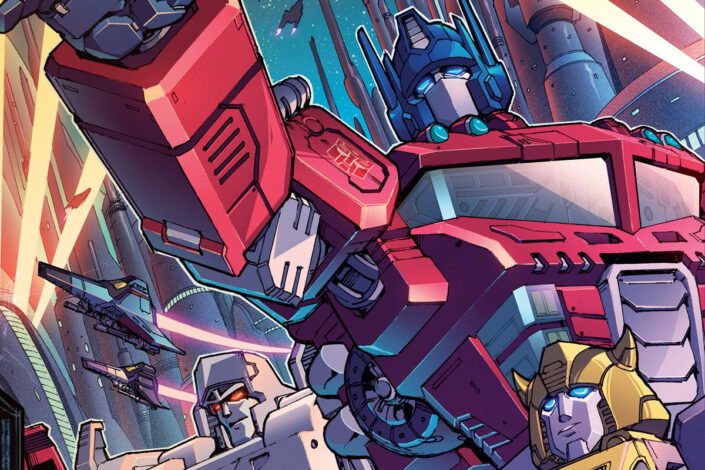
Transformers IDW Reading Order

  • by

Like with the Teenage Mutant Ninja Turtles, the Buffyverse, or the G.I. Joe comic book franchise, IDW took over the Transformers comics and launched its own continuity–and there are some discussions about the more legitimate continuity, but it’s not the subject of this article. We are here to talk about the third Transformers comics series.

The first was published by Marvel (from 1984 to 1991), and the second by Dreamwave Productions (from 2002 to 2004). After that, IDW Publishing took over with the third series (the Generation 1 continuity) written by Simon Furman starting with issue #0 in October 2005 and a regular series starting in January 2006 (and ending in November 2018). The fourth series is a relaunch at IDW that started in 2019.

And so, as the official synopsis tells it, it began on Earth, in 2006. The fate of the planet is already sealed, its destiny decided… by the marauding mechanical beings known as Decepticons. In their way stand an embattled crew of seven hardy Autobot warriors, sworn to prevent the impending Armageddon at any cost, and an unlikely trio of human misfits, pulled kicking and screaming into a hitherto hidden world of pain and hurt. The can of worms is open, the genie is out of the bottle… and nothing will ever be the same again! It begins again — here, now — the saga of the war-torn robots in disguise, the Transformers!

In 2022, IDW Publishing lost the license to publish Transformers comics. Skybound Entertainment (an imprint of Image Comics) took it over and created the Energon Universe.

Read More »Transformers IDW Reading Order