Skip to content

Fabien

Knull Reading Order, The King in Black
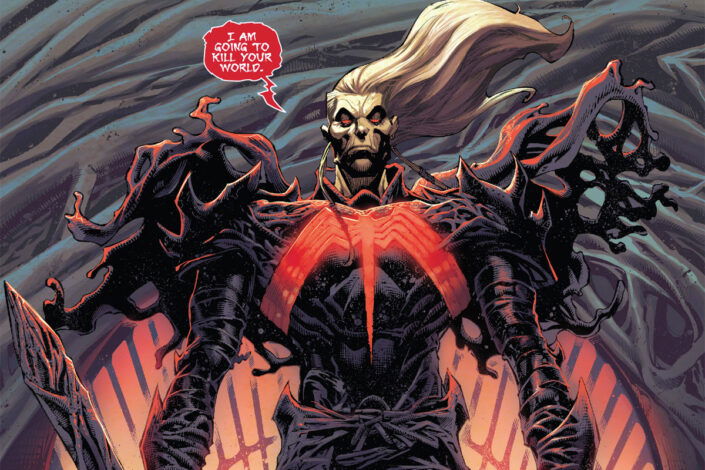
In recent years, the most significant new villain to emerge in the Marvel Comics Universe is Knull, the King in Black. Created by writer Donny Cates and artist Ryan Stegman, he first appeared in Venom #3 (2018) and slowly grew to become one of the biggest cosmic menaces the superheroes had to face.

Knull is introduced as the god of the symbiotes and one of the primordial beings of the Marvel Universe. As his story unfolds, we learn that he existed before the current Marvel Universe, in the endless void that preceded creation. When the Celestials began shaping the universe, their light angered him, leading him to forge the first symbiote (the All-Black Necrosword) and wage war against them. After decapitating a Celestial, Knull used its head to forge more weapons and eventually created the symbiote species, which he bound into a hive mind under his control.

An embodiment of darkness and nihilism, Knull has powers that make him able to manipulate darkness and, obviously, maintain control over the symbiote, but he is also “immortal” and possesses godlike strength.

While Knull was at the center of the King in Black crossover event, he appeared before that, becoming a real menace to Eddie Brock and the rest of the Marvel Universe. He and his All-Black Necrosword.
Read More »Knull Reading Order, The King in Black

Teen Titans Go! Comics Reading Order

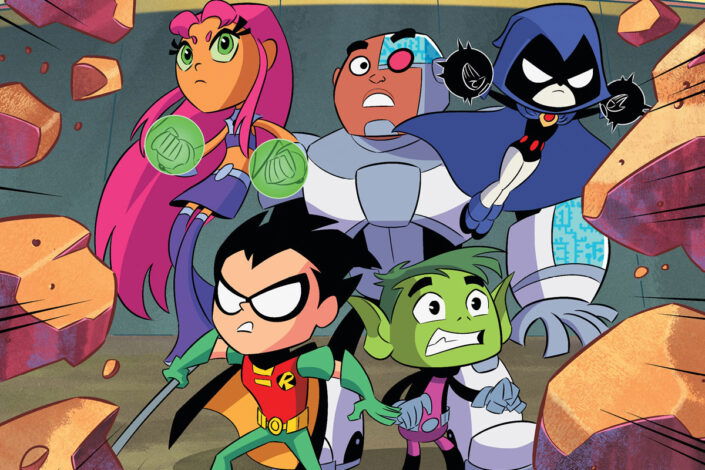
The first time Teen Titans Go! was used as a title on a DC Comics property was with the comic book spin-off of the 2003 Cartoon Network Teen Titans animated series created by Glen Murakami. The show went on for 5 seasons, officially ending in 2006 with a movie. 

A very popular show in its time, Teen Titans eventually spun off another animated TV show on Cartoon Network, this one titled Teen Titans Go!, and was developed by Aaron Horvath and Michael Jelenic. Still ongoing, it was launched in 2013 following the popularity of DC Nation’s New Teen Titans shorts. The series is only loosely connected to the original show, featuring occasional references and cameos but adopting a far more comedic and parodic tone.

Primarily aimed at a younger audience, Teen Titans Go! quickly became a cultural phenomenon, noted for its self-aware humour, fast-paced gags, and frequent pop culture references. Like its predecessor, this new series has also received its own comic book spin-off, expanding the franchise into print while maintaining the humour-driven style and broad appeal of the show.

Read More »Teen Titans Go! Comics Reading Order

Black Hammer Reading Order by Jeff Lemire and Dean Ormston

  • by

Black Hammer is an American comic book series created by writer Jeff Lemire and artist Dean Ormston, published by Dark Horse Comics. It tells a different kind of superhero story, mixing mythology with elements of mystery and rural drama in a way that explores the psychological and emotional consequences of heroism. A very Twilight Zone take on the genre.

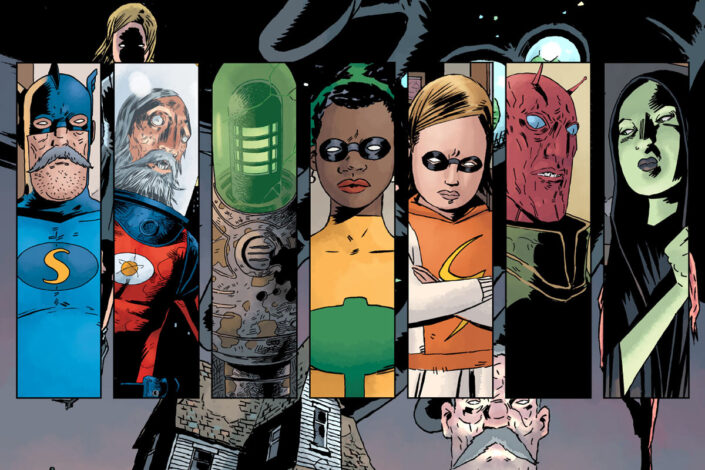
The story begins a decade after an epic battle in which the legendary hero Black Hammer and the other costumed champions of Spiral City, known as the Parazone Defenders, defeated the cosmic entity Anti-God. Despite their victory, the heroes vanished in the aftermath of the fight. To the outside world, they were presumed dead.

In reality, the group became inexplicably trapped in the small, timeless town of Rockwood, a rural community isolated from the rest of existence. Any attempt to leave is met with failure. As a matter of fact, Black Hammer himself died trying. Without a way to escape their confinement, Abraham Slam, Golden Gail, Colonel Weird, Madame Dragonfly, and Barbalien adopt new identities and attempt to lead ordinary lives, struggling with their fading memories, growing despair, and uncertainty about the nature of their imprisonment.

Launched in 2016, the original critically acclaimed Black Hammer comic book series has since expanded into a shared universe through numerous spin-offs and companion series, collectively known as The Hammerverse.

Read More »Black Hammer Reading Order by Jeff Lemire and Dean Ormston

A Guide to Grant Morrison comics at DC Comics

If you have read American superhero comics or searched for unconventional indie titles over the past three decades, you will certainly have come across Grant Morrison’s work.

Born in 1960 in Glasgow, Scotland, Morrison emerged in the British comics scene during the late 1970s and early 1980s, gaining recognition with comics such as Zenith (1987-1992) for 2000 AD before following Alan Moore‘s steps and joining the “British Invasion” of writers recruited by DC Comics who reshaped American superhero comics during the 1980s and 1990s.

Morrison began in 1988 with Animal Man, which quickly earned acclaim for its postmodern take on the superhero genre, combining environmental themes with metafictional commentary. This was followed by Doom Patrol, where Morrison’s surreal and avant-garde storytelling redefined the series and solidified their reputation for revitalizing obscure characters. By the early 1990s, Morrison had become central to DC’s publishing strategy, contributing both to mainstream superhero titles and the emerging Vertigo imprint.

After a period at Marvel in the early 2000s, Morrison returned to DC to lead a new era of high-profile projects, ambitious narratives, and large-scale crossover events, consolidating their reputation as one of the publisher’s most innovative and influential writers. Today, Morrison’s work is regarded as essential to the modern DC canon, with their influence visible across the company’s most notable publications.

And now, let’s take a closer look at Morrison’s works at DC Comics!

Read More »A Guide to Grant Morrison comics at DC Comics

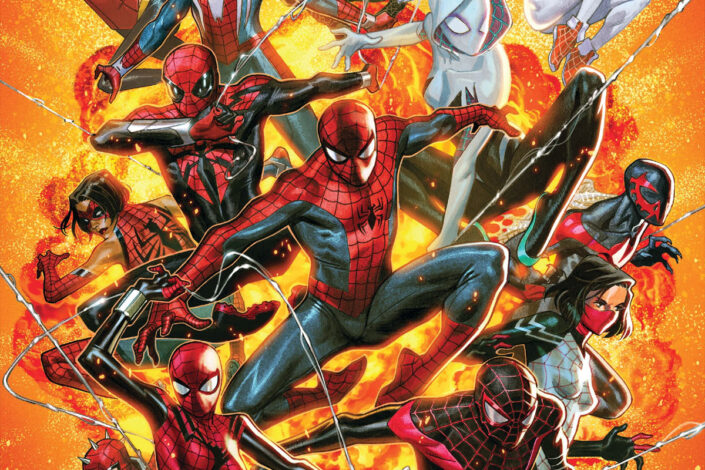
Spider-Man Spider-Verse Reading Order (with all the sequels!)

  • by

Now widely known thanks to the 2018 animated movie Spider-Man: Into the Spider-Verse, the “Spider-Verse” is not one of those concepts that Marvel introduced decades ago. In fact, it was conceived as a crossover event written by Dan Slott, with art by Olivier Coipel and Giuseppe Camuncoli, in 2014. An idea that was inspired by Slott’s work on the 2010 video game Spider-Man: Shattered Dimensions.

Since then, the Spider-Verse has become way bigger than a simple crossover. It can now almost be considered a line of comics inside the Spider-Man publishing world. There have been sequels to the original crossovers, spin-off series, and short story anthologies. The whole concept has been used in every other media featuring Spider-Man.

Everything started years ago, during J. Michael Straczynski’s Coming Home story, when Morlun was introduced. He is a powerful being who hunts and consumes “Spider-Totems” (the essence of spider-powered heroes). When the first Spider-Verse event starts, Morlun is back with his horrible family, the Inheritors, who begin exterminating spider-characters throughout the multiverse to feed on their force. Every single Spider-Man ever is needed to save the day!

The Spider-Verse treats every alternate take on Spider-Man as part of a connected multiverse: classic Peter Parker, Miles Morales, Spider-Gwen (Gwen Stacy), Spider-Man 2099, Spider-Ham, Japanese Spider-Man with his giant robot Leopardon, and countless others. Now, there are constantly new Spider-Heroes introduced, ready to fight to save all the spiders.

Read More »Spider-Man Spider-Verse Reading Order (with all the sequels!)

55 Must Read Biographical Comics

There have been non-fiction comics for a long time. In fact, that’s what one of the appeals of True Comics (1941-1950) was, which provided educational material in a form that appealed to children while trying to help legitimize the medium maligned by criticism of superhero books. They were fairly simplified biographies of scientists, inventors, and other figures of history. It was also less impactful than Crime Does Not Pay (1942-1955), the first “true crime” comic book series, which propelled the crime comics to the top with its sensationalistic appeal.

We are not talking about “true crime” today (it will be the subject of another list), but biographical comics. Not just works of documentary value, but also autobiographies, personal memoirs, from the groundbreaking series American Splendor (1976–2008), that changed the idea of what stories comic books could tell, to the artists of the 2000s (James Kochalka, Kate Beaton, Julia Wertz, etc.) who developed their craft online by chronicling the story of their lives, and beyond.

Today, biographical comics are a widely respected genre. They range from meticulously researched historical biographies to intimate diaries and experimental visual essays. They are studied in classrooms, exhibited in museums, and celebrated with major literary awards. This once niche corner of comics has become one of its richest and most innovative traditions.

Read More »55 Must Read Biographical Comics

DCAU Comics Reading Order: The Extended DC Animated Universe

With the launch of the Batman: The Animated Series, a new and popular version of the DC Comics universe found its way to a new generation of fans. While not connected to the main line of comics, it borrowed a lot, adapted many comics into episodes, and also created new stories and characters that would eventually be later introduced in the canonical timeline of the post-Crisis DC Comics Universe.

With its easily recognizable art style and its own developing universe, Batman: TAS opened the way for what we know call the DC Animated Universe. Guided by producers Bruce Timm, Paul Dini, Alan Burnett, and others, it’s whole universe of animated shows that was created with Superman: The Animated Series (1996–2000), Batman Beyond (1999–2001), and Justice League (2001–2004) along with its follow-up Justice League Unlimited (2004–2006), but also a new line of comics was launched.

Although primarily aimed at younger readers, the comics were noted for their storytelling quality, which appealed to a broader audience. It often introduced original characters, bridged episode narratives, and explored side stories within the DCAU continuity. Serving both as accessible entry points for new readers and as canonical expansions of the animated franchise, the comics were typically written and illustrated by creators closely associated with the animated productions, including Kelley Puckett, Ty Templeton, and Rick Burchett, ensuring fidelity to the shows’ tone, characterizations, and art style.

Over time, the DCAU comics evolved into a cohesive publishing universe in their own right. The universe has been revisited through miniseries, specials, and digital-first projects well into the 2020s, establishing it as one of DC Comics’ most enduring multimedia spin-offs.

Read More »DCAU Comics Reading Order: The Extended DC Animated Universe

Big Barda Reading Order, The Fiercest of DC Comics Furies

With a name like that, it’s no surprise that Big Barda is no ordinary warrior among the DC Comics superheroes. She’s one of the New Gods. Created by writer and artist Jack Kirby, Barda made her first appearance in Mister Miracle #4 (1971), as part of Kirby’s “Fourth World” saga.

A warrior raised on the planet Apokolips, Big Barda was trained to lead the Female Furies, an elite fighting force in the service of the tyrant Darkseid. After aiding Scott Free, also known as Mister Miracle, to escape from their world, she accompanied him to Earth, where the two built a life together outside of Darkseid’s control. Their marriage became one of the most enduring partnerships in the DC Comics universe.

Depicted as physically imposing (way more than her husband) and exceptionally skilled in combat, Barda quickly distinguished herself as one of the most powerful female characters in the DC Universe. On Earth, she has been a member of the Justice League and also joined the Birds of Prey. 

Read More »Big Barda Reading Order, The Fiercest of DC Comics Furies

Blade Runner Comics Reading Order (Titan Comics)

In 1982, Blade Runner, directed by Ridley Scott, premiered in movie theaters and didn’t become a hit. However, it became a Marvel Comics title as it was adapted into a two-issue miniseries by Archie Goodwin, Al Williamson, and Carlos Garzon. With the film becoming a cult classic, those comics are not the last to be associated with the franchise.

Based on the 1968 novel “Do Androids Dream of Electric Sheep?” by Philip K. Dick, Blade Runner follows Rick Deckard of the Los Angeles Police Department’s Replicant Detection Unit. In Scott’s neo-noir science fiction film, it’s 2019, and Deckard is charged to hunt down a group of replicants, biorobotic androids virtually identical to adult humans, that have escaped an off-world colony and now hide on Earth. 

The cyberpunk franchise had extended to other media with novels, video games, and comics, even before the 2017 movie Blade Runner 2049, directed by Denis Villeneuve, which brought back Harrison Ford as Deckard on the big screen. This sequel set the stage for the subsequent comics series published by Titan Comics and Alcon Publishing, a collection of maxiseries focusing on LAPD’s best Blade Runner and detective, Aahna ‘Ash’ Ashina, but also a few more spin-off miniseries.

Read More »Blade Runner Comics Reading Order (Titan Comics)

36 Lovecraftian Horror Comics and Graphic Novels

Next to Edgar Allan Poe, H.P. Lovecraft (1890-1937) is one of the most influential American writers in the horror genre. Though largely unrecognized in his lifetime, his work in the genre of weird fiction went on to shape generations of horror writers and artists. His stories are built around themes of cosmic dread, forbidden knowledge, and humanity’s insignificance in an uncaring universe, and often center on incomprehensible alien entities, ancient gods, and the fragility of sanity.

This type of tale has come to be known as Lovecraftian horror, also referred to as “cosmic horror.” It emphasizes atmosphere and existential terror over gore or jump scares. The horror lies not in what is seen, but in what cannot be fully understood. Over time, this distinctive approach to fear has taken root in a wide range of media, including comics, where artists and writers have found rich material in Lovecraft’s mythos and mood.

There are two types of Lovecraftian comics. We have the direct adaptations of H.P. Lovecraft’s original works, and the comic books full of cosmic horrors inspired by the master of the genre.

Today, we invite you to explore the shadowy, unsettling world of Lovecraftian horror through our selection of comics. From quiet tales of creeping madness to confrontations with ancient, godlike beings, these works capture the essence of a genre where fear comes not from what is known, but from what can never be fully understood.

Read More »36 Lovecraftian Horror Comics and Graphic Novels