Skip to content

DC Comics

Batman Reading Order, The Modern Age (Post-Crisis)

Batman stands on a rooftop, looking at Gotham City | Comic Book Treasury

Do you really need an introduction? Created by artist Bob Kane and writer Bill Finger in Detective Comics #27 (1939), Batman is a vigilante who fights crime in the streets of Gotham City. Under the costume of the Bat is Bruce Wayne, a wealthy American playboy, philanthropist, and industrialist whose parents, Thomas and Martha, were murdered in front of him when he was a kid. That traumatic existence led him to train himself physically and intellectually to be able to fight for justice.

Introduced as a generic ruthless and murderous vigilante, Batman quickly evolved and acquired a strong moral code (he is against murder!) and a kid sidekick, the famous Robin (Dick Grayson at first in Detective Comics #38). He never got superpowers, though. But that didn’t stop him from becoming one of the most iconic characters in popular culture.

As years went by, Batman’s comic book stories evolved. After the war, they became bright and colorful. During the 1950s, they became more science fiction-oriented, but they went back to more detective stories in the 1960s (and got redesigned) to avoid cancellation. The campy TV Show also influenced the book for a while, but soon after it ended, it became necessary to return to something grimmer.

The sales dropped anyway through the 1970s and 1980s. Then came the Modern Age. With the post-Crisis in Infinite Earths relaunch of the DC books came new instant-classic comic book stories–also, a popular movie helped.

This article does not cover all of Batman comics’ publication history. We are starting with what is called the Modern Age (aka Post-Crisis). The Golden Age Years are collected in Omnibus editions and DC Comics is now doing the same with the Silver Age Years (and also the Batman & Superman: World’s Finest comics), the Batman: The Brave & the Bold comics (Bronze Age) — see our guide for the Batman Comics from the Golden Age through the Bronze Age to explore the Pre-Crisis Batman era.

DC Comics’ Modern Age started after the 12-issue miniseries Crisis on Infinite Earths (see reading order). The event was used to retcon the histories of most of the characters. The idea was to clean up the timelines (something DC Comics is still trying to do, in vain) and to update the superheroes to appeal to a contemporary audience. With the help of Frank Miller and David Mazzucchelli, Batman got a new origin story. The relaunch didn’t erase all of Batman’s past, but some significant alterations became canon (like the fact that Alfred Pennyworth raised Bruce Wayne).

Read More »Batman Reading Order, The Modern Age (Post-Crisis)

The Death of Superman Reading Order

The Death and Return of Superman Reading Order

ABC launched the television series Lois & Clark: The New Adventures of Superman in 1993, where the marriage of Lois and Clarke was discussed during the production. Even if the comics and the show didn’t take place in the same continuity, Warner Bros wanted the Superman brand to stay consistent across all media. They wanted the wedding of the couple to happen at the same time on screen and paper.

What did it mean for the Superman comics? After all, the creative team was planning the wedding of Lois and Clark, and they had to stop and build a whole new storyline. Writer Jerry Ordway made the joke to just kill Superman, and it became the most attractive scenario for the creative team. If they couldn’t marry the Man of Steel, they could kill him… and make comic history!

That’s how the now-classic storyline The Death of Superman was born. It is divided into a trilogy of story arcs: “Doomsday!” (or Death of the Superman) leads to Superman’s Death; “Funeral for a Friend” is focused on the aftermath; and “Reign of the Supermen!” introduced the Supermen. For Lois Lane fans, it’s also an important period, as the death of Superman puts her on the front line, and she was used as the glue between all the titles. After this trilogy, the inevitable happens, titled “The Return of Superman”.

Launched at the end of 1992, The Death (and Return) of Superman was published almost all the year 1993. The creative team consisted of Dan Jurgens, Louise Simonson, Roger Stern, Jerry Ordway, Karl Kesel, William Messner-Loebs, and Gerard Jones on the writer front. Jon Bogdanove, Tom Grummett, Jackson Guice, Dan Jurgens, Dennis Janke, Denis Rodier, Walt Simonson, Curt Swan, and M. D. Bright on the artist front.

One of the biggest best-sellers at DC, The Death (and Return) of Superman had a major impact on the company, as a similar event happened shortly after with Batman: Knightfall (reading order), followed by the deaths of numerous superheroes. Also, some characters established during the arc became recurring characters afterward.

No doubt about it, The Death (and Return) of Superman occupy a special place in Superman and DC history, and today, we revisit it with a reading order, and the different ways to read this iconic story.

What to read before The Death of Superman?

Like a lot of readers at the time of publication, you can just go straight ahead without any required reading before. A few issues teased Doomsday breaking free from his prison, and we have listed them in the issue-by-issue reading order for the occasion.


I just told you no background reading was necessary, but for those out there who like to know a little more, here are a few things to know:

  • The Justice League’s incarnation at the time of this storyline was Justice League International, with Booster Gold, Blue Beetle, Guy Gardner, and more. It was written by Dan Jurgens.
  • A few issues during that storyline are part of the Bloodlines event.
  • Not long ago, Luthor faked his own death and transplanted his brain into a clone of himself, which he passed off as his unknown son, Lex Luthor II, raised by foster parents in Australia to protect him from Luthor’s enemy. The charade is completed by an Australian accent, a full head of red hair, and a beard. Luthor uses this opportunity to seduce Supergirl (Matrix at the time). Those issues where those events take place are not really well collected (between Action Comics #660 and #678).
  • Finally, if you simply want to discover more stories with Superman, check out our Superman Reading Order, The Modern Age (Post-Crisis).

Read More »The Death of Superman Reading Order

Fourth World Reading Order, Jack Kirby’s DC Comics Epic Saga

  • by

Jack Kirby's Fourth World Reading Order

Jack Kirby’s name is mostly associated with Marvel, but he left to join DC Comics from 1970 to 1973. During that time, he created the Fourth World Saga. Even if, in the end, The King was not treated better by DC than he was at Marvel, his work there was still heavily influential. In fact, DC would not be what it is today without it.

When he joined DC Comics, Jack Kirby took over Superman’s Pal Jimmy Olsen and, with issue #133 (Oct. 1970), he began the Fourth World. The three other original titles in which the saga developed were The Forever People, Mister Miracle, and The New Gods. The story is basically about the battle between good and evil as represented by the worlds of New Genesis and Apokolips.

Here is the story: Raised in exile as a living instrument of peace between Apokolips and New Genesis, Orion swore to uphold the life-affirming values of his adopted world. But the bottomless rage and thirst for combat that course through his veins cannot be extinguished. In the end, will he defeat Darkseid and thwart his quest for the Anti-Life Equation–or will he forsake his vow and seize the ultimate power for himself?

Read More »Fourth World Reading Order, Jack Kirby’s DC Comics Epic Saga

Dead Boy Detectives Reading Order, From the Sandman Universe

  • by

Neil Gaiman’s Sandman (reading order here) led to the creation of multiple spin-offs, not all became as successful as Lucifer (reading order here). It was the case with The Dead Boy Detectives, two young sleuths that are also ghosts.

Created by Gaiman and artist Matt Wagner in Sandman #25, The Dead Boy Detectives are Charles Rowland and Edwin Paine. Edwin was murdered at his boarding school in 1916 and he went to Hell. But when Hell was emptied of its residents, Edwin and the souls of past teachers and pupils came back to the boarding school when Charles and a few teachers stayed for the holidays.

They didn’t survive and Charles became a ghost, like Edwin. The two boys decided to forego going to the afterlife with Death and became detectives investigating crimes involving the supernatural.

Read More »Dead Boy Detectives Reading Order, From the Sandman Universe

Milk Wars Reading Order, a DC/Young Animal crossover
  • by

Milk Wars Reading Order (DC/Young Animal crossover)

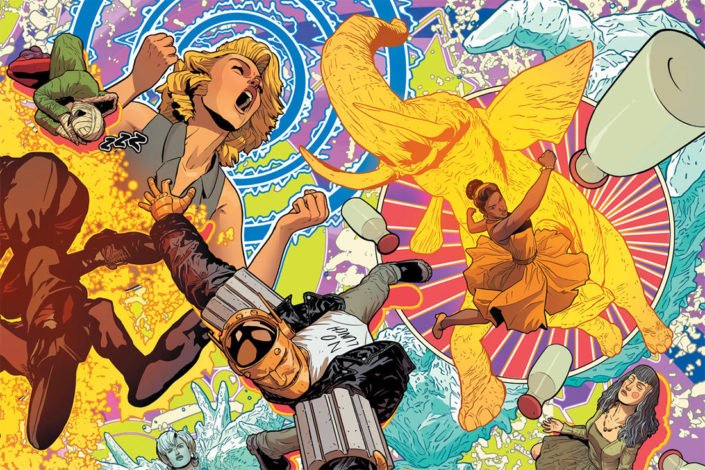
DC’s Young Animal is a pop-up imprint launched in 2016 in collaboration with Gerard Way, musician and writer of the Umbrella Academy with the purpose of relaunching characters with a more experimental approach. It gives us four ongoing series: Doom Patrol, Shade the Changing Girl, Cave Carson Has a Cybernetic Eye, and Mother Panic.

In the middle of 2018, those four titles entered in collision with the mainstream DC Universe thanks to the Milk Wars event, a crossover with the Justice League, when the inter-dimensional corporation Retconn hijacked the DC Continuity with the goal to make the whole DC Universe more wholesome.

What to read before Milk Wars?

There is no pre-requisite reading for the Justice League, as the story has no connection with what was happening at the time for our heroes. For them, it doesn’t occupy a particular place in the timeline. That’s not the case for the Young Animals’ characters. The Milk Wars event takes place after volume 2 of each title — Doom Patrol’s story leads directly into the event.

With that said, it is a self-contained event supposedly new reader-friendly. Will it be confusing? Probably, but chances are it’ll still be even with prior reading due to the nature of the story itself.

Read More »Milk Wars Reading Order, a DC/Young Animal crossover
Invasion! Reading Order, a DC Crossover Event

  • by

DC Invasion Reading Order

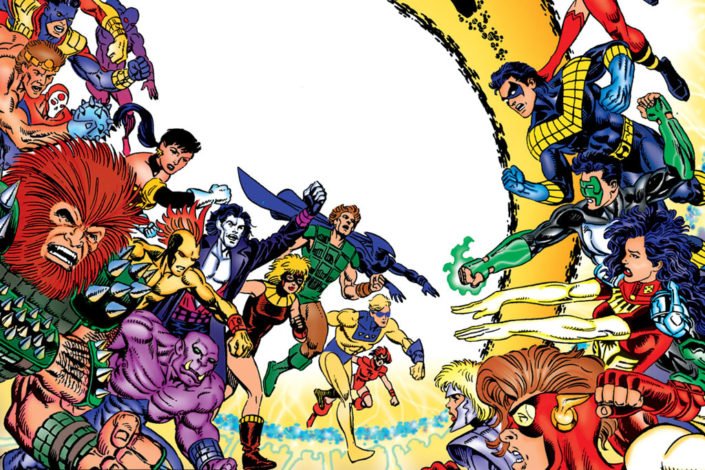
Published in late 1988-early 1989 by DC Comics, Invasion! is crossover event plotted by Keith Giffen (from Justice League International) with the main series scripted by Bill Mantlo (with art from Todd McFarlane, Bart Sears, and Giffen). It was the biggest DC event since Crisis on Infinite Earths, and it was about the heroes of Earth facing a massive Alien invasion. It is now known for its introduction of the metagene as the explanation within the DC Universe as to how some people gain superhuman abilities. Also, it’s the inspiration for the 2016 TV crossover event between the series from the Arrowverse on The CW.

Here is the official synopsis: Resilient. Overpowering. Unstoppable. By their very nature, our planet’s superheroes have become a threat to the rest of the universe. Now, an alliance has formed between the fiercest, most calculating alien races (led by the war-like Dominators and Khunds) to pursue a single goal: the elimination of Earth’s guardians. As war erupts all over the world, Superman leads the charge against these would-be alien conquerors. Can our planet’s greatest champions repel an army of invaders, each with the strength to rival the Man of Steel? One thing is certain: surrender is not an option!

What to read before Invasion?

You don’t really need to read anything specific before Invasion!, but these (optional) issues contain minor references to the event to come.

  • Wonder Woman (vol. 2) Annual #1 & #24
  • Adventures of Superman #448
  • The Flash (vol. 2) #20
  • Swamp Thing (vol. 2) #80
  • Spectre (vol. 2) #22

Read More »Invasion! Reading Order, a DC Crossover Event

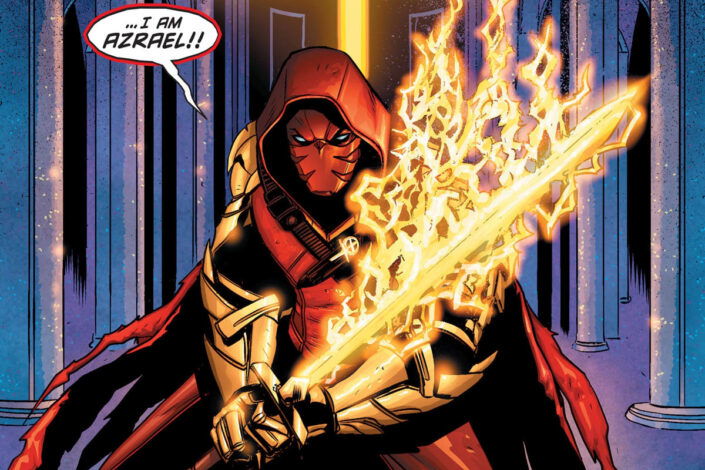
Azrael Reading Order (aka Jean-Paul Valley)

  • by

Introduced in Batman: Sword of Azrael #1 (October 1992), Azrael is a DC Comics character created by Denny O’Neil, Joe Quesada, and Peter Milligan. When we met Jean-Paul Valley, he was a Gotham University graduate student and his father had just died and made him his successor in the Sacred Order of St. Dumas.

He became their warrior known as the vigilante Azrael. He was not an enemy of Batman and eventually joined him and his allies in their fight to protect Gotham City—he also played a controversial role during the Knightfall event.

We later discovered that Jean-Paul was created by “Mother,’ a villain who worked with the Order of St. Dumas. For a time, Azrael did the dirty work the Order needed him to do, but Nightwing put him on the right path so he could help people. He then started to fight crime.

Azrael is an antihero, a conflicted warrior who fights his violent nature and the twisted sense of justice forced on him by his indoctrination in the Order. Because of that, he had to earn his place in the BatFamily, and he often has to prove he is good enough to keep it.

Read More »Azrael Reading Order (aka Jean-Paul Valley)

Robin War Reading Order

  • by

Robin War Reading Order

Published by DC Comics between December 2015 to January 2016, Robin War is a crossover event featuring most of the incarnations of Batman’s crime-fighting partner, Robin, including Damian Wayne, Tim Drake, Jason Todd, and the original, Dick Grayson. It was set during that time when Commissioner Gordon replaced Batman by using a robotic Bat-suit (see Batman New 52 or Batman by Snyder & Capullo) and the We Are Robin movement put the spotlight on the young crimefighters.

Here is the official synopsis: In a Gotham City turned upside down, Robin has become more than a single hero—Robin is a movement. With Bruce Wayne sidelined and the Batman co-opted by the police, a legion of teens are putting on the yellow “R” and following in the footsteps of their crime-fighting icons. But all it takes is one tragic accident for everything to go wrong. And when it does, the crackdown on the Robins is swift and merciless. Now, all of the original Boy Wonders—Dick Grayson, Jason Todd, Tim Drake and Damian Wayne—are back in Gotham, determined to save the kids who have taken up their legacy.

This Robin War is not as spontaneous as it seems. From their shadowy lair, Gotham’s oldest and most powerful secret society is manipulating all sides of the conflict—and not even those who trained for years with the World’s Greatest Detective can guess the true purpose behind the Court of Owls’ intricate plan—for more information about the Court here.

What to read before Robin War?

As the Robin War event is connected to the Court of Owls, I invite you to take a look at our reading guide dedicated to this secret society. But the essential is:

Before reading Robin War, you may want to be up-to-date with the new “Robins” group. It’s in the pages of the We are Robin series.

Optional, but if you want to know more about Gordon as Batman, take a look at Batman, Vol. 8: Superheavy, Pt. 1.

Read More »Robin War Reading Order

DC One Million Reading Order

  • by

Dc One Million Reading Order

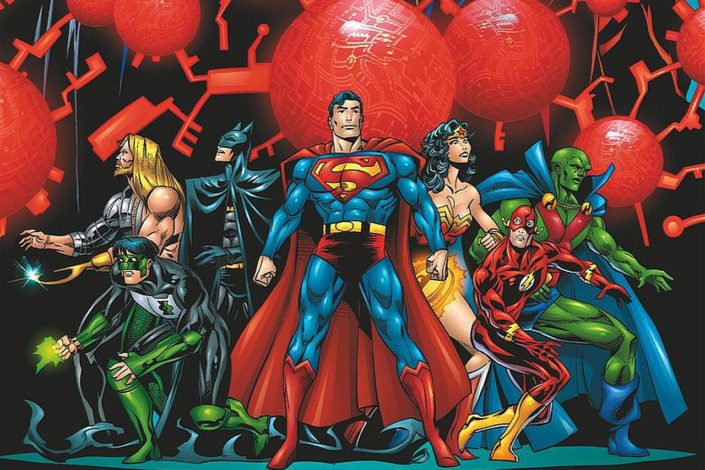
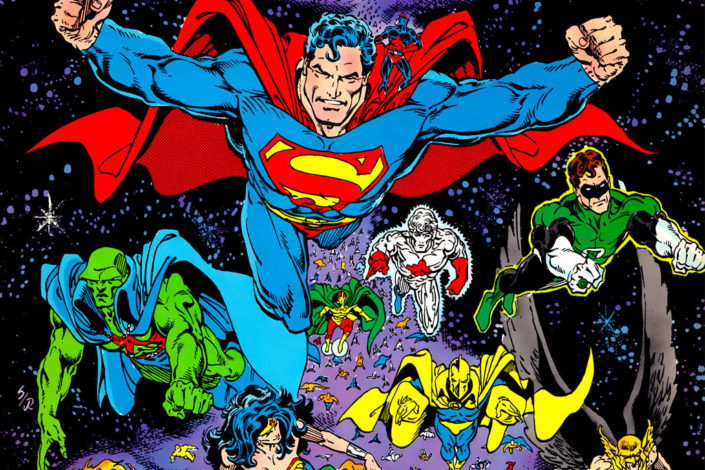
Get ready to go to the 853rd Century! DC One Million was a 1998 event written by Grant Morrison and drawn by Val Semeiks set a million issues in the future – meaning, in the 853rd Century 

In this possible future, Earth remains safe, thanks to the heroics of the JLA of the future. The descendants of Batman, Superman, Wonder Woman, The Flash, and others remain united in combating forces of evil but perhaps have never met anything as deadly as the sentient super-computer Solaris, the Tyrant Sun. As this villainous threat becomes too much to handle, these heroes of the future turn to the only group they know can help: the original JLA.

The core of the event was a four-issue mini-series, and the thirty-four other series then being published by DC also put out a single issue numbered #1,000,000, which either showed its characters’ involvement in the central plot or gave a glimpse of what its characters’ descendants/successors would be doing in the 853rd century.

What to read before DC One Million?

DC One Million is a stand-alone event, meaning that you don’t need any pre-plot knowledge before diving into it.

It takes place during Grant Morrison’s run (see reading order) and more precisely, after JLA #23, as the final two pages of this issue lead into the story. But, those famous two pages have almost never been included in the several reprints (from JLA: Strength in Numbers trade paperback to the digital version available on ComiXology to even the DC One Million Omnibus hardcover or trade paperback collections). 

If you want to read those two pages (which includes the return of Diana as the team’s Wonder Woman), you will have to get hold of JLA Deluxe Edition Vol. 3 hardcover

Read More »DC One Million Reading Order

Wonder Woman Reading Order

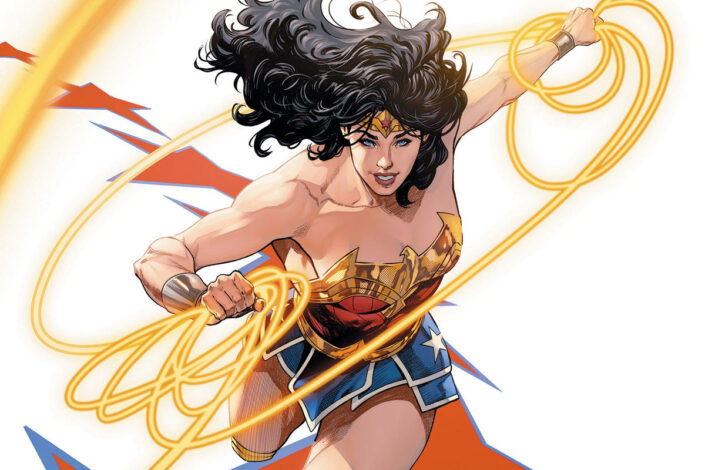
Princess Diana of Themyscira is Wonder Woman, the most famous female superhero in the Patriarch’s World and a powerful feminist icon. Known in her civilian identity as Diana Prince, she hails from the hidden island of Themyscira, home of the Amazons, and is a founding member of the Justice League.

Armed with her Lasso of Truth, indestructible bracelets, and razor-sharp tiara, Diana battles gods, mythical beasts, and formidable foes—including her most persistent enemies in her rogues gallery: Ares, Cheetah, Doctor Poison, Circe, Doctor Psycho, and Giganta.

Created by William Moulton Marston, a psychologist and writer inspired by his wife Elizabeth Marston and their partner Olive Byrne, Wonder Woman was brought to life by artist Harry G. Peter and made her debut in All-Star Comics #8 on October 21, 1941.

Her origin story has been reimagined many times, but its core remains the same: a champion of justice who fights with strength and compassion, even toward her enemies. It often begins with Captain Steve Trevor’s plane crashing on Themyscira, leading Diana to win the right to escort him back to the outside world—the “Patriarch’s World.” To honor her mission, her mother, Queen Hippolyta, bestows upon her a sacred uniform, marking her as Wonder Woman.

She is a princess, a warrior, and an ambassador. Beautiful as Aphrodite, wise as Athena, stronger than Hercules, and swifter than Mercury—she is Wonder Woman!

Read More »Wonder Woman Reading Order