Skip to content

Marvel

Fantastic Four Reading Order

In November 1961, a page of comic book history was written when the Fantastic Four comic debuted. The first issue was an unexpected success, and the public simply fell in love with the First Family. It played a massive role in making Marvel the company we know, launching and influencing the superhero comics in a new direction.

Traditionally, the Fantastic Four are Reed Richards (Mister Fantastic), scientific genius and leader; Susan “Sue” Storm (Invisible Woman), Reed’s partner and co-leader; Johnny Storm (The Human Torch), Sue’s little brother; and Ben Grimm (The Thing), pilot and best friend. They all gained superpowers following exposure to cosmic rays during a scientific mission to outer space.

The Fantastic Four are maybe the most famous superheroes in the Marvel Universe, as they chose to become celebrities instead of hiding their real identities from the public.

If the name of the team implies they are only four members, the roster of the famous ‘family’ has changed several times, and sometimes, other characters have been members. Crystal, Medusa (from the Inhumans), She-Hulk, Ant-Man (Scott Lang), Storm and Black Panther, and even Spider-Man have been at some point or other members of the team.

They fought and stop more than once the Supreme Leader Doctor Doom but also had several encounters with Galactus, Ronan the Accuser, Namor, Silver Surfer, the Mole Man, the Frightful Four, and more. They worked with the Avengers, the X-Men, and other Marvel superheroes to save the world.

This most emblematic team has lived a lot, and it’s time to explore those adventures with our Complete Fantastic Four reading order!

Read More »Fantastic Four Reading Order

Luke Cage Reading Order, Marvel’s Power Man

At the beginning of the 1970s, Blaxploitation movies became quite popular and Marvel Comics wanted to cash in on the trend–as well as with other trends, see Ghost Rider or Werewolf by Night. Luke Cage was then introduced as an urban African-American hero like no other.

Described at the time as “a combination of Superman and Shaft,” Luke Cage was created by Archie Goodwin, George Tuska, Roy Thomas, and John Romita Sr. He made his first appearance in Luke Cage, Hero for Hire #1 (June 1972). He was the first black American superhero to have his own comic book series at Marvel Comics (Black Panther is not an American!).

Introduced as a prisoner in “Little Alcatraz,” the Seagate Prison, Carl Lucas is recruited by research scientist Dr. Noah Burstein to be a test subject in a cellular regeneration experiment based on a variant of the Super-Soldier process. Lucas gains superstrength and escapes. He ends up in New York City’s Harlem neighborhood where he grew up and reinvents himself. Now call Luke Cage, the “Power Man,” he becomes a freelance “hero for hire.”

The Hero for Hire comics was not a hit, but Luke Cage rapidly found his place in the Marvel universe. He befriended the Fantastic Four, fought next to the super-team the Defenders, developed a relationship with Dr. Claire Temple, and teamed up with Iron Fist and Misty Knight…

Read More »Luke Cage Reading Order, Marvel’s Power Man

Winter Soldier (Bucky Barnes) Reading Order

  • by

From the beginning, Captain America wasn’t fighting AXIS alone. He had a sidekick: Bucky. Created by Joe Simon and Jack Kirby, Bucky made his first appearance in Captain America #1 in March 1941, and remained by Captain America’s side throughout the war.

Both men disappeared while on a classified mission towards the end of the war, after which they were declared dead. Although Captain America was reintroduced in The Avengers #4 (1964) after being discovered frozen in ice by the Avengers, Bucky was considered dead. Captain America’s last memory of him was watching the plane he was on explode. And for a long time, Bucky was among a select group of comic book characters well known for remaining deceased, alongside Jason Todd and Uncle Ben.

Like the second Robin, Bucky was brought back to life in the noughties by writer Ed Brubaker in one of the most famous Captain America runs. More precisely, it was revealed that he hadn’t died at all. After being rescued by a Russian submarine, he was brainwashed and trained to become the deadly assassin known as the Winter Soldier. Back among the living, Bucky entered a whole new chapter, from being a brainwashed killing machine to Captain America and a quest for redemption, and back to the Winter Soldier. 

A classic character from the Golden Age, Bucky Barnes was successfully reinvented for the modern era. This version also came to life on the big screen, with Sebastian Stan playing the character in the Marvel Cinematic Universe.

From Captain America to The Winter Soldier and leader of the New Avengers, discover all the comics featuring Bucky Barnes in our Winter Soldier Reading Guide.

Read More »Winter Soldier (Bucky Barnes) Reading Order

Spider-Man Dark Web Reading Order, a Marvel crossover featuring Spider-Man and the X-Men

Barely one month after the A.X.E.: Judgment Day event, the X-Men are caught in a new crossover. However, this one also revolves around Spider-Man. Written by Zeb Wells and drawn by artist Adam Kubert, Dark Web is about clones. Here is the official synopsis:

“The worlds of Spider-Man and the X-Men collide, thanks to the unholy alliance of Madelyne Pryor, AKA the Goblin Queen, and Ben Reilly, now known as Chasm! The two most famous and famously wronged clones are back…and they’re going to claim what’s rightfully theirs! The Dark Web they spin over Manhattan is going to change the NYC skyline forever!”

So, the Dark Web event involves Spider-Man and the X-Men, but also Mary Jane Watson, Black Cat (Felicia Hardy), Venom (Eddie Brock), Ms. Marvel (Kamala Khan), and Scarlet Spider (Ben Reilly).

Read More »Spider-Man Dark Web Reading Order, a Marvel crossover featuring Spider-Man and the X-Men

Namora: The Origin and History of Namor’s Cousin

  • by

Less than ten years after Namor made his debut, his female counterpart was introduced on the pages of Marvel Mystery Comics #82. Namora – full name Aquaria Nautica Neptunia – is, like her cousin Namor, a hybrid and one of Marvel’s first mutants.

Soon played by Mabel Cadena on the big screen in Black Panther: Wakanda Forever, Namora was created by artist Ken Bald (and an unknown writer), though several of her Golden Age appearances were written by Bill Everett who also designed her costume.

She’s the daughter of an Atlantean father and a human mother who lived several adventures next to her cousin in the Golden Age but was unfortunately killed off in the ‘60s. Namora continued to appear in a number of flashbacks but only made her permanent return to the Marvel Universe in 2006.

Though Namora didn’t have the chance to become a major player in the Marvel Universe, she still had the time to become a hero and make the undersea world safer!

Read More »Namora: The Origin and History of Namor’s Cousin

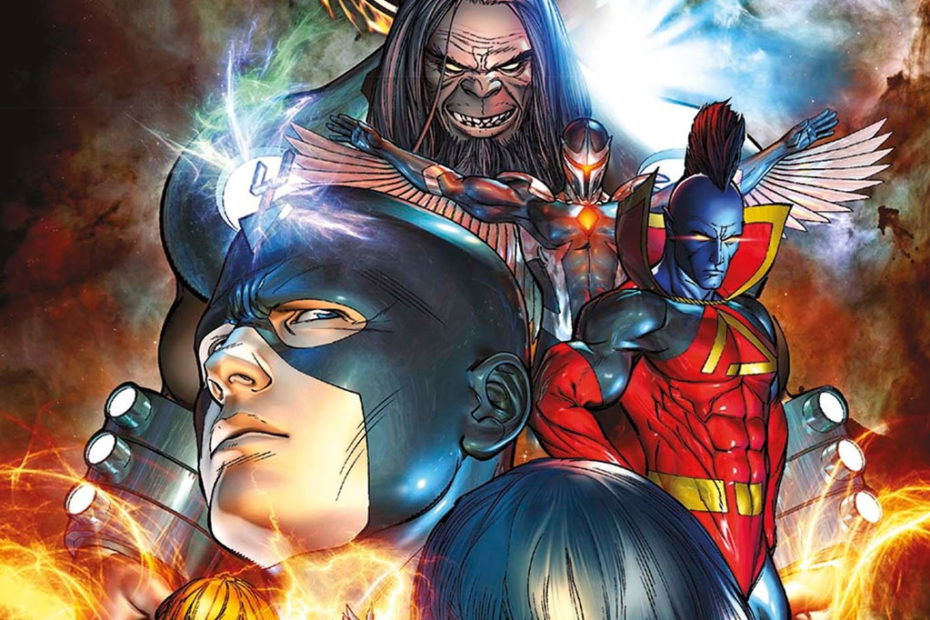
Inhumans Reading Order (with Black Bolt, Medusa, Karnak, Lockjaw and Maximus)

While they are often compared to the X-Men, the Inhumans occupy a unique, cosmic corner of the Marvel Universe. Created by the legendary duo Stan Lee and Jack Kirby in 1965 (Fantastic Four #45), these powerful beings aren’t just “born with it,” they are the product of ancient alien engineering and a ritualistic transformation that changes their lives forever.

Inhumans vs. Mutants: What’s the Difference?

The primary difference lies in the source of their power. While Mutants carry the X-Gene that naturally activates during puberty, Inhumans are the result of Kree science experiments. To gain their abilities, an Inhuman must undergo Terrigenesis, a process where they are exposed to the Terrigen Mist (vaporized Terrigen Crystals).

Originally intended as weapons for the Kree-Skrull War, the Inhumans instead formed a secluded, highly advanced society governed by the Royal Family and the Genetic Council.

Read More in The Origins of The Inhumans, Marvel’s Royal Family.

Meet the Inhuman Royal Family

To understand the best Inhumans stories, you have to know the key players living in their lunar kingdom of Attilan:

  • Black Bolt: The King, whose voice is so destructive that a mere whisper can level a city.
  • Medusa: The Queen, with powerful, prehensile hair.
  • Crystal: Mistress of the elements (fire, water, earth, air).
  • Karnak: The philosopher who never underwent Terrigenesis but can see the flaw in all things.
  • Maximus: Black Bolt’s brother, a mad genius.
  • Lockjaw: The fan-favorite giant bulldog with the power of teleportation.

From Classic Lore to the NuHumans

The Inhuman mythos expanded significantly in recent years with the arrival of NuHumans. These are individuals with dormant Inhuman DNA living among humans who were transformed when a Terrigen Cloud drifted across Earth. This era gave us modern icons like Kamala Khan (Ms. Marvel), Daisy Johnson (Quake), and Moon Girl.

With over 50 years of complex political drama, cosmic wars, and genetic evolution, diving into their history can be daunting. Whether you’re a fan of the classic Kirby era or the modern “Inhumanity” event, here is the definitive Inhumans reading order to guide you through the mists.

Read More »Inhumans Reading Order (with Black Bolt, Medusa, Karnak, Lockjaw and Maximus)

Ghost Rider Reading Order

  • by

Marvel introduced a western character named Ghost Rider in 1967, but he is now known as the Phantom Rider. The Ghost Rider we are talking about here made his burning entrance in 1972 in Marvel Spotlight #5 and was created by Roy Thomas, Gary Friedrich, and Mike Ploog.

The original idea behind Ghost Rider came from Gary Friedrich as he developed a villain to be used in the page of Daredevil. Intrigued, Roy Thomas decided that the character should have his own series. He even suggested that the costume should be inspired by one Elvis wore in his comeback special in 1968. Mike Ploog took their concept and designed the biker, introducing the head on fire just because he thought it looked cool.

There is more than one Ghost Rider. The first was Johnny Blaze, a stunt motorcyclist who gave his soul to Mephisto to save his adopted father’s life. After that, he discovers that he was bonded with the demon Zarathos. Now, he is forced to punish the wicked and evil as the Ghost Rider, a violent biker with a flaming head. Though, he only transformed when he is in the presence of evil.

At the beginning of the 1990s, Marvel introduced a new Ghost Rider, the young Danny Ketch. In 2014, it was the turn of Robbie Reyes, a Mexican-American resident of East Los Angeles, who’s not a biker. His ride is a muscle car.

Others became temporarily Ghost Riders, and the mythology behind the characters, as well as its history, evolved through the years. As the host or the ride changed, the Ghost Rider’s abilities also changed. Every rider is different, but the fight against Evil never stops.

Read More »Ghost Rider Reading Order

Thanos Reading Order

The Marvel Comics supervillain Thanos first appeared in The Invincible Iron Man #55 in February 1973. He was created by writer and artist Jim Starlin, who was inspired by Jack Kirby’s work on DC’s New Gods. He was Marvel’s response to Darkseid, following instructions from Roy Thomas, but Starlin also drew inspiration from his college psychology classes when creating Thanos and Drax the Destroyer.

Hailing from Titan, Saturn’s moon, Thanos is the son of the Eternals A’lars and Sui-San. After falling in love with the physical embodiment of Death, Thanos finally became the murderous nihilist monster feared by the universe. He killed millions on Titan, but that was just the beginning. In order to do more, he started seeking universal power in the form of the Cosmic Cube.

This quest led to the creation of his enemy, Drax the Destroyer, and confrontations with Captain Marvel and other superheroes. But his story ended… for a time. He was resurrected in the 1990s, when Jim Starlin launched his Infinity Saga — a classic Marvel tale of epic proportions. Thanos resumed his quest to find the Infinity Gems.

After that, he became a constant menace, concocting evil plans that only made sense to him. Even when defeated, he always came back.

Read More »Thanos Reading Order

Spider-Man Reading Order, The Complete and Amazing Adventures of Peter Parker

With issue #15 (May 1962), the anthology comic book Amazing Adult Fantasy was renamed Amazing Fantasy after Marvel realized teenagers were uncomfortable buying a title with “Adult” in its name. The issue introduced “The Spiderman,” a teenage superhero created by Stan Lee and Steve Ditko, who was meant to headline the series, but Amazing Fantasy was canceled shortly after. The character, soon renamed Spider-Man, became an instant success and quickly earned his own ongoing comic book series.

Spider-Man’s story begins with Peter Parker, a geeky orphaned high school student from Queens, New York, living with his Uncle Ben and Aunt May. After being bitten by a radioactive spider during a science exhibit, Peter gains spider-like agility and strength. At first, he uses his powers for fame and money, but after refusing to stop a thief who later causes Uncle Ben’s death, Peter learns the lesson that defines his life: “With great power there must also come great responsibility!

From then on, Peter Parker balances fighting criminals with everyday struggles like helping Aunt May pay the bills, studying, and working as a photographer for the Daily Bugle, where publisher J. Jonah Jameson constantly attacks Spider-Man in print. Over the years, Peter meets Harry Osborn, Gwen Stacy, and Mary Jane Watson while facing enemies like the Green Goblin, Doctor Octopus, and the Sinister Six. His life is marked by tragedy, personal loss, and constant challenges as the Marvel Universe expands around him.

Spider-Man eventually teams up with heroes like the Fantastic Four and The Avengers, becoming one of Marvel Comics’ most important characters. Loved by readers but often hated within his own world, Spider-Man grew into one of the most recognizable fictional characters ever created, starring in movies, television shows, video games, and more.

This article focuses entirely on the comic books, returning to the beginning of Spider-Man’s long publishing history to explore his reading order from the very start.

Read More »Spider-Man Reading Order, The Complete and Amazing Adventures of Peter Parker

Thunderbolts Reading Order

  • by

Following the events of 1996’s Onslaught, the Avengers and the Fantastic Four were declared dead. A new group of ‘superheroes’ decided to step in to help protect the world: The Thunderbolts!

Considered the equivalent of DC’s Suicide Squad, The Thunderbolts was created by Kurt Busiek and Mark Bagley and they made their first appearance in The Incredible Hulk #449 (January 1997) before the launch of their ongoing series the following month.

What seemed to be a basic superhero team then changed on the last page, when it was revealed that The Thunderbolts, led by Baron Zemo, were actually the Masters of Evil in disguise! This is known as one of the most famous twists in Marvel history.

With themes of redemption and heroism, The Thunderbolts will walk away from their evil nature, choosing to reject Baron Zemo and try to become heroes in their own right. Throughout the years, this team of anti-heroes has worked to do good things when led by Hawkeye, Luke Cage, and the Winter Soldier, but has also been used as a dangerous and malevolent force by leaders like Norman Osborn and Wilson Fisk. As you can imagine, between changes in leadership and direction, the roster of the team has changed a lot over the years.

A new version of Thunderbolts will soon be on the big screen, as a movie featuring the team will be released in 2024. Before that, you can start reading The Thunderbolts, and exploring their past (and present) history with this reading order!

Read More »Thunderbolts Reading Order