Skip to content

Fabien

Co-founder of Comic Book Treasury, your Hellboy Specialist and the man behind the Batman Modern Age and the Amazing Spider-Man Guides.
Starman Reading Order, the celebrated James Robinson run

  • by


The original Starman debuted in Adventure Comics #61 (April 1941) and was created by writer Gardner Fox and artist Jack Burnley. Ted Knight, a brilliant scientist, developed the Gravity Rod—later upgraded to the Cosmic Rod—which allowed him to manipulate energy, fly, and generate force fields. As Starman, he became a key Golden Age superhero and a founding member of the Justice Society of America.

Decades later, in 1994, DC Comics introduced a new take on the Starman legacy with the Starman series, written by British writer James Robinson and illustrated by Tony Harris. The series, which ran from 1994 to 2001, focused on Jack Knight, Ted’s younger son, who reluctantly inherited the Starman mantle after his older brother, David, was murdered. Unlike traditional superheroes, Jack refused to wear a costume or conceal his identity. He was more interested in running his antique and collectibles store in Opal City than fighting crime.

The story begins when Ted Knight’s longtime enemy, The Mist, resurfaces, launching an attack that forces Jack into action. Despite his reluctance, he wields the Cosmic Rod and, over time, grows into the role of Starman, though on his own terms. The series explored themes of legacy, family, and personal growth, making it one of the most critically acclaimed superhero comics of the 1990s.

Robinson’s Starman is notable for its rich world-building, incorporating past Starmen from DC history and revamping the villain Shade, a morally complex former villain who becomes Jack’s unlikely ally. The series concluded in 2001 with Jack ultimately stepping away from superhero life—a rare instance of a major DC hero being allowed to retire voluntarily. He passed the mantle to the young Courtney Whitmore, aka Stargirl.

What to read before James Robinson’s Starman?

Before writing the ongoing Starman comics, James Robinson collaborated with Paul Smith on The Golden Age miniseries in which they revisited the Golden Age Justice Society. This comic book is part of the Elseworlds collection, but he still used elements of that story in his work. It’s not obligatory reading, but it gives a good insight into the old-school characters.

Read More »Starman Reading Order, the celebrated James Robinson run

GI Joe Comics Reading Order, A Real American Hero!

  • by

When I wrote this article, it was announced that IDW would stop publishing GI Joe Comics. It’s now a done deal and the Joe-verse has been relaunched by Skybound as part of their Energon Universe. This is a new entry point, but if you are interested in getting back to the beginning with what was originally done at Marvel Comics and later at IDW, this is your guide.

As a licensed property by Hasbro, G.I. Joe comics have been released from 1967 to today (except between 1977 and 1981, and between 1997 and 2000), but it was not anything of note before the launch of G.I. Joe: A Real American Hero in 1982.

“’G.I. Joe’ is the code name for America’s daring, highly trained special mission force. Its purpose: to defend human freedom against Cobra, a ruthless terrorist organization determined to rule the world.”

Hasbro relaunched the toy line and needed some promotion to go with it (there’s an episode of The Toys That Made Us on Netflix about that). At that time, the move to go with a comic book tie-in G.I. Joe series was not a sure thing, but Larry Hama who wrote most of the comics made it a success (with art by Herb Trimpe at first). He created a solid and realistic military universe with great mythology to go with it and interesting characters.

With 155 issues and several spin-offs, G.I. Joe: A Real American Hero was a hit for a long time at Marvel Comics. It ended in 1994. A second and a third G.I. Joe comic book series were published by Devil’s Due Productions from 2001 to 2008 (80 issues and some spin-offs), then it was revived by IDW Publishing (like Teenage Mutant Ninja Turtles and Transformers) with issue 155 ½ written by Larry Hama who picked up the story where he had left it at Marvel Comics. From there, a lot of GI Joe Comics was published. A Lot.

Read More »GI Joe Comics Reading Order, A Real American Hero!

War For Earth-3 Reading Order

  • by

Written by Robbie Thompson and Dennis “Hopeless” Hallum, with art by Steve Pugh (War for Earth-3), Eduardo Pansica, Julio Ferreira, Dexter Soy (Suicide Squad), Fernando Pasarin (The Flash), and Mike Norton (Teen Titans Academy), War for Earth-3 is a 2022 crossover storyline composed of a 2-part limited series and issues from Suicide Squad, The Flash, and Teen Titans Academy.

Here is the official synopsis: The Teen Titans, the Flash and the Suicide Squad all collide on Earth-3—home of the evil Crime Syndicate—on the hunt for former Task Force X mastermind Amanda Waller.

As Waller tries to take over the alternate Earth and dethrone evil versions of Superman, Wonder Woman, Batman, and other heroes that rule it, her former partner—Rick Flag—arrives on E-3 bent on making Waller pay for her crimes, while the Titans and Flash hunt for a missing academy student they believe was kidnapped by Waller to form her mysterious Justice Squad.

What to read before War For Earth-3?

First, to know more about the evil Crime Syndicate of Earth-3, you have to read the miniseries spinning out of Dark Nights: Death Metal written by Andy Schmidt with art by Bryan Hitch and Keiron McKeown:

After The War For Earth-3 crossover event, the ongoing series of Suicide Squad and Teen Titans Academy will soon be concluded, you may want to be up-to-date with this two at least (especially with Suicide Squad).

As for The Flash, it’s now Wally West show and you can read about his return in:

Read More »War For Earth-3 Reading Order

Brian Michael Bendis’ Avengers Reading Order, from Disassembled to Avengers vs. X-Men

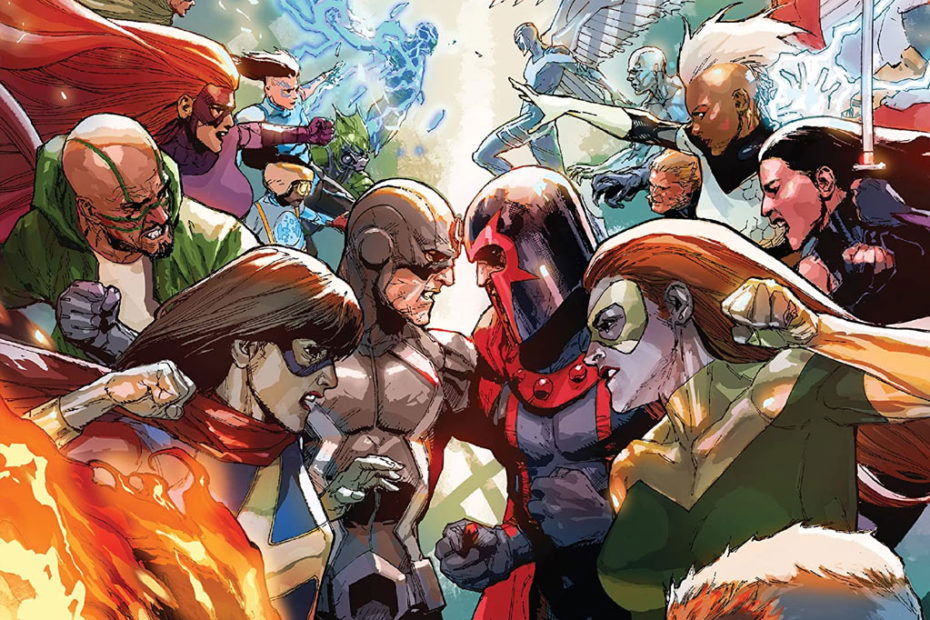
In 2004, Brian Michael Bendis’s Avengers run began with the destruction of the existing traditional roster of the team. It was the end of an era and the start of a new one that ended up being a series of crossover events that changed the Marvel Universe in a big way.

At first, with the Avengers in ruins, a new team named The New Avengers is created: Iron Man, Captain America, Luke Cage, Wolverine, Ronin (aka Echo), Spider-Man, Spider-Woman, and Sentry. It was also the title of the main Avengers series written by Bendis—with art by David Finch, then by Steve McNiven, Leinil Francis Yu, Billy Tan, and Stuart Immonen as the years went by.

But that’s not all! After some massive events, a concurrent government-sanctioned team led by Ms. Marvel (with Ares, Black Widow, Iron Man, Sentry, Wasp, and Wonder Man) gathered in The Mighty Avengers—also originally written by Brian Michael Bendis with art by Frank Cho, then Mark Bagley. But that’s not all! There also was the Dark Avengers—also originally written by Brian Michael Bendis with art Mike Deodato…

After eight years, Brian Michael Bendis ended his run on Avengers and New Avengers in 2012 with the “End Times” arc. He wrote multiple series, miniseries, and events to create one big superhero story.

Read More »Brian Michael Bendis’ Avengers Reading Order, from Disassembled to Avengers vs. X-Men

Batman Reading Order, The Modern Age (Post-Crisis)

Batman stands on a rooftop, looking at Gotham City | Comic Book Treasury

Do you really need an introduction? Created by artist Bob Kane and writer Bill Finger in Detective Comics #27 (1939), Batman is a vigilante who fights crime in the streets of Gotham City. Under the costume of the Bat is Bruce Wayne, a wealthy American playboy, philanthropist, and industrialist whose parents, Thomas and Martha, were murdered in front of him when he was a kid. That traumatic existence led him to train himself physically and intellectually to be able to fight for justice.

Introduced as a generic ruthless and murderous vigilante, Batman quickly evolved and acquired a strong moral code (he is against murder!) and a kid sidekick, the famous Robin (Dick Grayson at first in Detective Comics #38). He never got superpowers, though. But that didn’t stop him from becoming one of the most iconic characters in popular culture.

As years went by, Batman’s comic book stories evolved. After the war, they became bright and colorful. During the 1950s, they became more science fiction-oriented, but they went back to more detective stories in the 1960s (and got redesigned) to avoid cancellation. The campy TV Show also influenced the book for a while, but soon after it ended, it became necessary to return to something grimmer.

The sales dropped anyway through the 1970s and 1980s. Then came the Modern Age. With the post-Crisis in Infinite Earths relaunch of the DC books came new instant-classic comic book stories–also, a popular movie helped.

This article does not cover all of Batman comics’ publication history. We are starting with what is called the Modern Age (aka Post-Crisis). The Golden Age Years are collected in Omnibus editions and DC Comics is now doing the same with the Silver Age Years (and also the Batman & Superman: World’s Finest comics), the Batman: The Brave & the Bold comics (Bronze Age) — see our guide for the Batman Comics from the Golden Age through the Bronze Age to explore the Pre-Crisis Batman era.

DC Comics’ Modern Age started after the 12-issue miniseries Crisis on Infinite Earths (see reading order). The event was used to retcon the histories of most of the characters. The idea was to clean up the timelines (something DC Comics is still trying to do, in vain) and to update the superheroes to appeal to a contemporary audience. With the help of Frank Miller and David Mazzucchelli, Batman got a new origin story. The relaunch didn’t erase all of Batman’s past, but some significant alterations became canon (like the fact that Alfred Pennyworth raised Bruce Wayne).

Read More »Batman Reading Order, The Modern Age (Post-Crisis)

Excalibur Reading Order (Marvel Comics)

  • by

Created by writer Chris Claremont and artist/co-writer Alan Davis, the Excalibur team made its debut in 1987 with Excalibur Special Edition #1 (also known as Excalibur: The Sword is Drawn). The series was conceived as a way to merge elements of two distinct Marvel properties: the X-Men and Captain Britain, combining British superheroics with mutant mythology.

The United Kingdom’s champion, Captain Britain, gained his powers with the guidance of the wizard Merlyn, and his shapeshifting partner Meggan, joined forces with former X-Men Nightcrawler and Kitty Pryde. Together, they confront threats such as Gatecrasher and her Technet, the Warwolves, the Juggernaut, Mojo, Arcade, the Crazy Gang, the X-Babies, and alternate universe adversaries like the Lightning Squad. The team operates from their lighthouse base in the United Kingdom but is drawn into global conflicts, including the chaos of Inferno in New York.

The original Excalibur series ran from 1988 to 1998, chronicling the adventures of the founding team. Like New Mutants, the title has been revived intermittently for limited runs and remains part of the broader Marvel continuity, including the more recent Krakoa Era, ensuring Captain Britain and his allies continue to play a role in contemporary storylines.

Read More »Excalibur Reading Order (Marvel Comics)

Doctor Strange Reading Order

Created by Steve Ditko with Stan Lee in Strange Tales #110 (1963) at a time when Marvel tried new things (like mysticism!), Doctor Strange is the Sorcerer Supreme, the main protector of Earth against magical and mystical threats. 

At first, he was just in a 5-page filler story but rapidly gained in visibility and popularity. Meet Stephen Strange, also known as Doctor Strange. But he is no ordinary doctor, being the Master of the Mystic Arts, a sorcerer supreme, a white knight who wields black magic against blacker villains still. Strange is mankind’s only hope against the dark otherworldly forces that conspire to destroy the conscious world. 

Doctor Strange was born in the heart of the counterculture era, mixing mysticism and psychedelia. The art was surrealist and he was an unconventional hero, but he found enough success in his niche to become the main character of the book that ended up renamed after him. His popularity was fluctuant and he jumped from his solo series to team books or even anthologies, never getting the exposition other big superheroes got.

The Sorcerer Supreme is now a big player in the Marvel Cinematic Universe, which led to new collected editions, but it may be hard to follow. So, here is the guide to the mystic adventures of Doctor Strange.

Where to start reading Doctor Strange? The Recommended Reading List

With more than 50 years of stories to discover, new readers may not be interested in reading everything from the start. Before our chronological reading order, here is a recommended reading list for Doctor Strange:

  • Doctor Strange: The Oath by Brian K. Vaughn and Marcos Martin – A story in which Doctor Strange sets out to solve an attempted murder – his own!
  • Dr. Strange Season One – A modern retelling of Doctor Strange’s origin story by Greg Pak and Emma Rios.
  • Doctor Strange by Jason Aaron (aka Volume 4) – A good and modern entry point for new readers who want an ongoing series, not just a one-shot.
  • Doctor Strange & Doctor Doom: Triumph and Torment by Roger Stern, Gerry Conway, and Mike Mignola. A graphic novel that took two unlikely allies, Strange and Doom, on a journey to Mephisto’s infernal realm.
  • Strange: The Doctor is Out by Mark Waid and Emma Rios. A 4-part miniseries. No longer Sorcerer Supreme of the Marvel Universe, Stephen Strange must discover a new path to fulfillment and enlightenment. 
  • Dr. Strange: What Is It That Disturbs You, Stephen? by Marc Andreyko and P. Craig Russell. From the arcane shadows of the Sanctum Sanctorum to the dizzying spires of the mystical city of Ditkopolis! 

Read More »Doctor Strange Reading Order

Annihilation Scourge Reading Order

  • by

Annihilation Scourge Reading Order - Nova

Back in 2006, Marvel relaunched its Cosmic Universe with the Annihilation crossover event. It led to a series of events of the same kind, but also to a new Guardians of the Galaxy series and more. You can find here our reading guide of that era piloted by Dan Abnett and Andy Lanning.

Since C. B. Cebulski became Marvel’s editor-in-chief in 2017, a lot of names associated with popular events of the past have been reused. It was the case in 2019 with Annihilation. This time though, it was not as ambitious as the first time. In fact, Annihilation Scourge works like a 6-part miniseries.

Here is the official synopsis: The Negative Zone is under siege! Now the Lord of the Negative Zone, Annihilus, makes a call for help to the very heroes he once fought against! It’s an all-out battle as Nova, Silver Surfer and some of your favorite cosmic heroes try to prevent the next annihilation.

Read More »Annihilation Scourge Reading Order

Fourth World Reading Order, Jack Kirby’s DC Comics Epic Saga

  • by

Jack Kirby's Fourth World Reading Order

Jack Kirby’s name is mostly associated with Marvel, but he left to join DC Comics from 1970 to 1973. During that time, he created the Fourth World Saga. Even if, in the end, The King was not treated better by DC than he was at Marvel, his work there was still heavily influential. In fact, DC would not be what it is today without it.

When he joined DC Comics, Jack Kirby took over Superman’s Pal Jimmy Olsen and, with issue #133 (Oct. 1970), he began the Fourth World. The three other original titles in which the saga developed were The Forever People, Mister Miracle, and The New Gods. The story is basically about the battle between good and evil as represented by the worlds of New Genesis and Apokolips.

Here is the story: Raised in exile as a living instrument of peace between Apokolips and New Genesis, Orion swore to uphold the life-affirming values of his adopted world. But the bottomless rage and thirst for combat that course through his veins cannot be extinguished. In the end, will he defeat Darkseid and thwart his quest for the Anti-Life Equation–or will he forsake his vow and seize the ultimate power for himself?

Read More »Fourth World Reading Order, Jack Kirby’s DC Comics Epic Saga

Superior Spider-Man Reading Order

Coming from Dan Slott, with artwork by Ryan Stegman, Humberto Ramos, and Giuseppe Camuncoli, The Superior Spider-Man series was launched after Amazing Spider-Man #700 in which Peter Parker finally loses his battle against Otto Octavius.

The famous Doctor Octopus swapped consciousnesses with Parker and left him to die in his decaying body to ensure his own survival. Otto became Peter, but arrogant as he is, he also decided to become a better Spider-Man than Parker ever was, and a better man than he was as Otto Octavius. He became the Superior Spider-Man.

This was a controversial move, but the Superior Spider-Man quickly became a fan favorite anyway. Of course, Peter Parker had to come back at some point, but Otto wore the costume for enough time to change things a little. And this was not the end of the Superior Spider-Man, as you’ll see in this reading order.

To know what came before The Superior Spider-Man series, take a look at our Dan Slott’s Amazing Spider-Man Reading Order.

Read More »Superior Spider-Man Reading Order