Skip to content

Batfamily

Batman RIP Reading Order

  • by

Batman RIP Reading Order

Some storylines are more complicated than you can think – or they just seemed weirdly confusing for no reason. In the case of Batman R.I.P., the complication (and confusion) comes from the fact that it’s connected to the Final Crisis event. This story concluded the first third of Grant Morrison’s Batman run (full reading order here), leading to a new status quo as the series was renamed Batman and Robin for a time.

Here is the official synopsis: The troubled life of Bruce Wayne seems to spin out of control when his relationship with the mysterious Jezebel Jet deepens. Soon Bruce Wayne drops out completely, having seemingly become the victim of mental illness and abandoning his Batman identity for a life on the streets of Gotham City. Capitalizing on the fall of their greatest foe, the Club of Villains begins a crime spree through the streets of Gotham that threatens to bring the city to its knees.

What to read before Batman R.I.P.?

  • Batman: The Black Casebook
    Collects Batman #65, 86, 112, 113, 134, 156 And 162, Detective Comics #215, 235, 247 And 267, And World’s Finest Comics #89.
  • Batman and Son (collects previous editions Batman & Son and The Black Glove in one volume)
    Collects Batman issues #655-658, #663-669 and #672-675.
  • Batman: Heart of Hush
    Collects Detective Comics #846-850.

  • Grant Morrison’s run and Batman R.I.P. take place during the Modern Age period. For more Batman’s adventures during this time, check out our Batman reading order, the Modern Age.

Read More »Batman RIP Reading Order

Shadow War Reading Order, a Batman, Robin & Deathstroke, Inc. crossover event

  • by

Since James Tynion IV stopped writing Batman, Joshua Williamson is the main writer of the series. He also writes Robin, Deathstroke, Inc., and everything linked to Infinite Frontier. This summer, he will be in charge of the Dark Crisis event, but before that he organized another crossover event in the Batmanverse called Shadow War—illustrated by Viktor Bogdanovic.

Here is how it starts: When Deathstroke assassinates Ra’s al Ghul, Talia al Ghul demands revenge and sends her League of Shadows to kill Deathstroke and Deathstroke Inc.! Batman and Robin must team up to track down Deathstroke and bring him to justice … but do they?

Expect over-the-top fights, action, mystery, and betrayal as this crossover event creates a major impact on the DCU!

What to read before Shadow War?

With this kind of event, it’s always better to be up-to-date, especially with Joshua Williamson’s writing. First, we’ve got Batman, the first story after the Fear State event, then Damian Wayne in Robin (see Damian Wayne Reading Order for more info), and Deathstroke in the new Deathstroke, Inc. series.

Read More »Shadow War Reading Order, a Batman, Robin & Deathstroke, Inc. crossover event

Batman Reading Order, The Modern Age (Post-Crisis)

Batman stands on a rooftop, looking at Gotham City | Comic Book Treasury

Do you really need an introduction? Created by artist Bob Kane and writer Bill Finger in Detective Comics #27 (1939), Batman is a vigilante who fights crime in the streets of Gotham City. Under the costume of the Bat is Bruce Wayne, a wealthy American playboy, philanthropist, and industrialist whose parents, Thomas and Martha, were murdered in front of him when he was a kid. That traumatic existence led him to train himself physically and intellectually to be able to fight for justice.

Introduced as a generic ruthless and murderous vigilante, Batman quickly evolved and acquired a strong moral code (he is against murder!) and a kid sidekick, the famous Robin (Dick Grayson at first in Detective Comics #38). He never got superpowers, though. But that didn’t stop him from becoming one of the most iconic characters in popular culture.

As years went by, Batman’s comic book stories evolved. After the war, they became bright and colorful. During the 1950s, they became more science fiction-oriented, but they went back to more detective stories in the 1960s (and got redesigned) to avoid cancellation. The campy TV Show also influenced the book for a while, but soon after it ended, it became necessary to return to something grimmer.

The sales dropped anyway through the 1970s and 1980s. Then came the Modern Age. With the post-Crisis in Infinite Earths relaunch of the DC books came new instant-classic comic book stories–also, a popular movie helped.

This article does not cover all of Batman comics’ publication history. We are starting with what is called the Modern Age (aka Post-Crisis). The Golden Age Years are collected in Omnibus editions and DC Comics is now doing the same with the Silver Age Years (and also the Batman & Superman: World’s Finest comics), the Batman: The Brave & the Bold comics (Bronze Age) — see our guide for the Batman Comics from the Golden Age through the Bronze Age to explore the Pre-Crisis Batman era.

DC Comics’ Modern Age started after the 12-issue miniseries Crisis on Infinite Earths (see reading order). The event was used to retcon the histories of most of the characters. The idea was to clean up the timelines (something DC Comics is still trying to do, in vain) and to update the superheroes to appeal to a contemporary audience. With the help of Frank Miller and David Mazzucchelli, Batman got a new origin story. The relaunch didn’t erase all of Batman’s past, but some significant alterations became canon (like the fact that Alfred Pennyworth raised Bruce Wayne).

Read More »Batman Reading Order, The Modern Age (Post-Crisis)

Azrael Reading Order (aka Jean-Paul Valley)

  • by

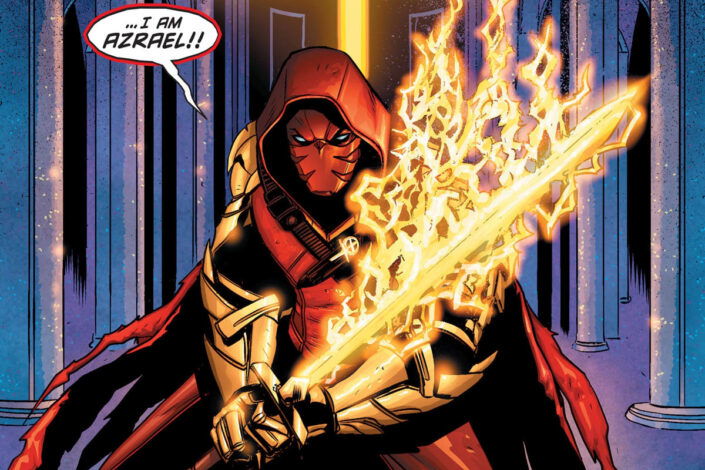
Introduced in Batman: Sword of Azrael #1 (October 1992), Azrael is a DC Comics character created by Denny O’Neil, Joe Quesada, and Peter Milligan. When we met Jean-Paul Valley, he was a Gotham University graduate student and his father had just died and made him his successor in the Sacred Order of St. Dumas.

He became their warrior known as the vigilante Azrael. He was not an enemy of Batman and eventually joined him and his allies in their fight to protect Gotham City—he also played a controversial role during the Knightfall event.

We later discovered that Jean-Paul was created by “Mother,’ a villain who worked with the Order of St. Dumas. For a time, Azrael did the dirty work the Order needed him to do, but Nightwing put him on the right path so he could help people. He then started to fight crime.

Azrael is an antihero, a conflicted warrior who fights his violent nature and the twisted sense of justice forced on him by his indoctrination in the Order. Because of that, he had to earn his place in the BatFamily, and he often has to prove he is good enough to keep it.

Read More »Azrael Reading Order (aka Jean-Paul Valley)

Robin War Reading Order

  • by

Robin War Reading Order

Published by DC Comics between December 2015 to January 2016, Robin War is a crossover event featuring most of the incarnations of Batman’s crime-fighting partner, Robin, including Damian Wayne, Tim Drake, Jason Todd, and the original, Dick Grayson. It was set during that time when Commissioner Gordon replaced Batman by using a robotic Bat-suit (see Batman New 52 or Batman by Snyder & Capullo) and the We Are Robin movement put the spotlight on the young crimefighters.

Here is the official synopsis: In a Gotham City turned upside down, Robin has become more than a single hero—Robin is a movement. With Bruce Wayne sidelined and the Batman co-opted by the police, a legion of teens are putting on the yellow “R” and following in the footsteps of their crime-fighting icons. But all it takes is one tragic accident for everything to go wrong. And when it does, the crackdown on the Robins is swift and merciless. Now, all of the original Boy Wonders—Dick Grayson, Jason Todd, Tim Drake and Damian Wayne—are back in Gotham, determined to save the kids who have taken up their legacy.

This Robin War is not as spontaneous as it seems. From their shadowy lair, Gotham’s oldest and most powerful secret society is manipulating all sides of the conflict—and not even those who trained for years with the World’s Greatest Detective can guess the true purpose behind the Court of Owls’ intricate plan—for more information about the Court here.

What to read before Robin War?

As the Robin War event is connected to the Court of Owls, I invite you to take a look at our reading guide dedicated to this secret society. But the essential is:

Before reading Robin War, you may want to be up-to-date with the new “Robins” group. It’s in the pages of the We are Robin series.

Optional, but if you want to know more about Gordon as Batman, take a look at Batman, Vol. 8: Superheavy, Pt. 1.

Read More »Robin War Reading Order

Cassandra Cain Reading Order (Batgirl, Orphan, Black Bat)

  • by

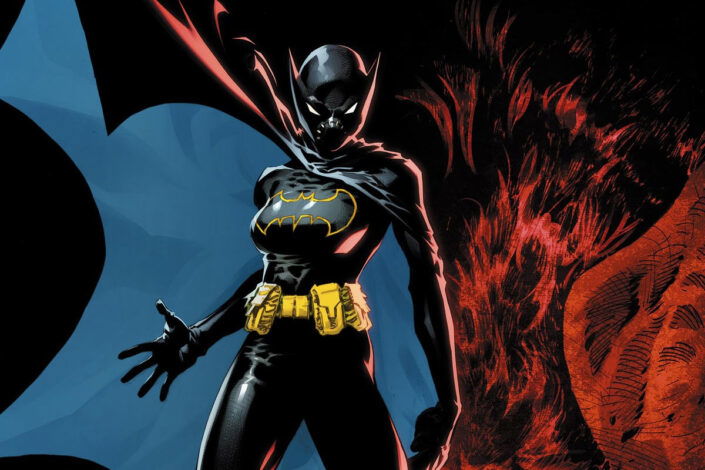
Created by Kelley Puckett and Damion Scott, Cassandra Cain is a member of the Batfamily who made her first appearance in Batman #567 (July 1999), during the No Man’s Land event. She then became the official Batgirl and got her own solo series. She’s also known as Black Bat and Orphan.

Cassandra Cain is the deadliest member of the Batfamily. The daughter of assassins David Cain and Lady Shiva, she was raised to be a killer. In fact, she was conditioned to become the world’s greatest assassin. To this end, she was deprived of speech and human contact during her childhood, which enabled her to develop an incredible ability to interpret body language to the extent that she could read complex thoughts. In essence, body movement was her first language, and she didn’t speak for a long time. This unique way of communicating has made her a martial artist like no other.

Batman took her under his wing and, with Barbara Gordon’s blessing, she soon became the new Batgirl. This happened before the New 52 era. After being reintroduced in the DCU in the Batman & Robin Eternal series, she got a new origin story.

Read More »Cassandra Cain Reading Order (Batgirl, Orphan, Black Bat)

Batman: Gothtopia Reading Order

  • by

Gothtopia Reading Order DC New 52

What if Gotham was a utopia where everybody is happy and no crimes happen? This is the reality shown in Batman: Gothtopia, a little Batman crossover published in 2014, during the New 52 era.

Here is the official synopsis: Who – or what – created this twisted vision of the Dark Knight’s hometown? As far as anyone knows, Gotham City is and always has been a crime-free utopia, patrolled by the white-clad Batman and his sidekick Selina Kyle, a.k.a. Catbird.

What to read before Gothtopia?

Gothtopia is a stand-alone storyline and doesn’t require any pre-reading. You can still pick up Birds of Prey (Volume 3) #27 in which there is a hint something weird is going on in Gotham, but nothing is shown.

Read More »Batman: Gothtopia Reading Order

Frank Miller’s Batman Series Reading Order (The Dark Knight Universe)

  • by

In 1996, Frank Miller reinvent Batman as a more controversial and ruthless figure in The Dark Knight Returns. And he followed up with Batman: Year One, cementing his version of Batman which will influence many writers.

In the DC Universe pre-flashpoint, all these tales are part of the Earth-31, also known as The Dark Knight Universe or Millerverse. On this Earth takes place the best and the worst of Batman’s stories.

Read More »Frank Miller’s Batman Series Reading Order (The Dark Knight Universe)

The Batman Who Laughs Reading Order (the breakout character of DC Comics’ Dark Nights Metal)

Batman Who Laughs Reading Order

Created by Scott Snyder and Greg Capullo in 2017, Batman Who Laughs was the breakout star of Dark Nights: Metal. This evil version of Bruce Wayne comes from Earth-22 of the Dark Multiverse.

Presented as Batman’s worst nightmare, he is a sort of hybrid of Batman and Joker. He is stripped of all sense of ethics, with Bruce Wayne’s intelligence and physical strength and the Joker’s psychopathy and warped, sadistic sense of humor. Without surprise, he has no problem killing people.

When Batman Who Laughs is introduced, he is a member of The Dark Knights, a team he assembled for Barbatos who wants to destroy the regular Multiverse.

This reading order gives you a listing to discover his story.

Read More »The Batman Who Laughs Reading Order (the breakout character of DC Comics’ Dark Nights Metal)

Nightwing Reading Order (Dick Grayson, Titan member, Outsiders leader, hero of Bludhaven and Gotham)

Created by Bill Finger, Bob Kane, and Jerry Robinson, Dick Grayson is one of the most compelling characters from DC Comics. From The Flying Graysons to being Robin (aka Batman’s sidekick), then to becoming Nightwing and finding his own way in life, he’s the friend you need, the leader who listens, the guy who wants to help and does good because it’s the right thing to do. And he’s always working to become a better version of himself and to make the world a better place. What’s not to love here?

Dick Grayson made his first appearance as Robin in Detective Comics #38 (April 1940), and grew up to become a superhero in his own right as Nightwing. Dick also took on the mantle of Batman on different occasions and was known as Agent 37 at one point.

Find out more about Dick Grayson’s story in our Nightwing Reading Order, which covers everything from his transformation into Nightwing in Tales of the Teen Titans #44 (July 1984) to the present day. You can read about his solo adventures, his time as Batman, his leadership of the Titans and the Outsiders, and much more!

Read More »Nightwing Reading Order (Dick Grayson, Titan member, Outsiders leader, hero of Bludhaven and Gotham)